A primary bath can face a private courtyard and still need discretion. A glass office partition can preserve a bright floor plan while exposing more than the client intended. Etched glass privacy panels resolve that tension with a material that admits daylight, softens views, and remains visually connected to the architecture around it.
For custom residences, hospitality settings, and carefully designed commercial interiors, this is not simply a decorative selection. The right panel depends on sightlines, lighting, safety requirements, panel size, hardware, and the degree of privacy the space actually needs. The difference between a graceful result and a disappointing one is usually decided well before fabrication begins.
What Etched Glass Actually Does
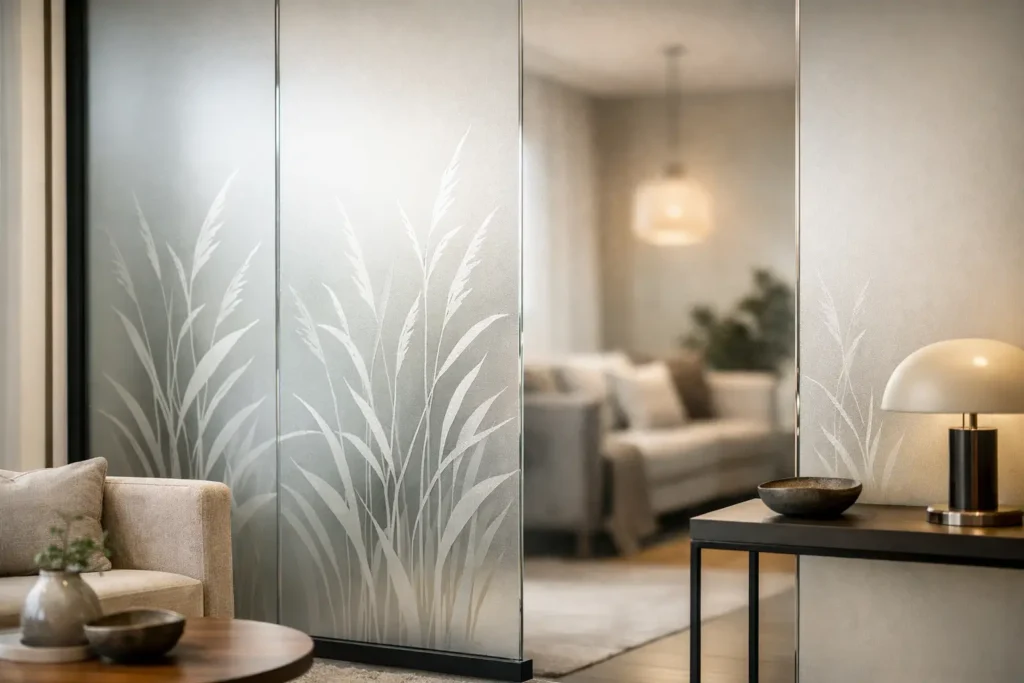
Etched glass has a permanently altered surface that diffuses light and obscures direct views. In architectural applications, the term may describe acid-etched glass with a consistent satin finish, or custom sandblasted work that can create patterns, gradients, borders, and tailored opacity. Both approaches can be beautiful, but they produce different visual effects and should not be treated as interchangeable.
Acid-etched glass generally offers an even, refined appearance across the panel. It is especially well suited to shower enclosures, interior doors, sidelites, and partitions where the design calls for a quiet, uniform surface. Sandblasting provides greater freedom for custom artwork and controlled patterns. A panel can be fully obscured, for example, or designed with a clear perimeter, a linear motif, or a transition from transparent to private.
Neither finish creates complete visual blackout. At close range, figures, movement, and contrast may still be visible, especially when one side of the glass is strongly illuminated. That distinction matters in powder rooms, dressing areas, street-facing entries, and guest suites. Privacy glass should be selected for the real viewing conditions of the project, not judged only from a small sample held in a showroom.
Where Etched Glass Privacy Panels Make the Strongest Impression
The most successful installations use etched glass as part of the architecture rather than an afterthought added to conceal a view. In a primary bathroom, it can shield a shower or water closet without turning the room into a sequence of enclosed compartments. In an entry, it can bring natural light through a front door sidelite while reducing exposure from the street. In a home office, it can separate work from living space without sacrificing the openness that made the room appealing.
Hospitality and commercial environments offer equally compelling opportunities. Private dining rooms, executive offices, wellness areas, treatment rooms, and lobby partitions often need separation without the heaviness of an opaque wall. A carefully specified etched treatment gives the space a measured sense of enclosure while allowing light to travel farther through the plan.
For coastal homes, privacy demands can change over the course of a property. An ocean-facing bath may be open to a distant view but visible from a neighboring terrace. A pool cabana may require screening from one direction while preserving a garden outlook from another. Custom panel layouts allow the glass to respond to those conditions with far more precision than a standard window covering or a fully solid partition.
Privacy Is a Specification, Not a Finish
A common mistake is asking whether glass is “private enough” without defining the location, distance, and lighting conditions involved. A lightly etched panel may be ideal between an interior hallway and a laundry room, yet insufficient for a ground-floor bath facing a neighboring property. Pattern density, placement, and illumination all affect performance.
Consider the view from both sides of the glass during the day and at night. Bright interior lighting can turn an obscured panel into a more visible silhouette from outdoors after sunset. Likewise, a shower enclosure set against a dark wall can appear substantially more private than the same enclosure positioned in front of a bright window.
Panel height matters as well. A half-height etched treatment may conceal the most sensitive sightline while retaining a clear upper portion for daylight and views. In other settings, full-height opacity is the better choice. The goal is not always maximum obscurity. It is a deliberate balance between privacy, light, and architectural intent.
Choosing the Right Glass and Fabrication Method
The base glass should be selected according to the application before the decorative treatment is finalized. Shower doors, railings, doors near walking surfaces, and many partition conditions require safety glazing. Tempered glass is common for these applications, while laminated glass may be appropriate where post-breakage retention, acoustic performance, or specific code conditions are part of the design.
This sequence is critical because architectural glass is fabricated in a precise order. Cutouts, notches, holes, edgework, and final dimensions must be resolved before tempering. Once tempered, glass cannot be cut or altered. Hardware locations for hinges, clamps, pulls, and door closers must be coordinated early, particularly on frameless systems where the glass itself carries the visual and structural responsibility.
For custom sandblasted panels, the design must also account for the relationship between the pattern and the panel edges, hardware, mullions, and adjacent materials. A pattern that looks balanced on a drawing can feel misaligned if a door pull interrupts it or if a narrow clear border lands awkwardly against stone or millwork. Full-scale review is often worthwhile for prominent installations.
Surface Orientation and Maintenance
An etched surface has a texture, even when it feels smooth to the touch. In wet environments, that texture can hold soap residue and mineral deposits more readily than polished clear glass if cleaning is neglected. The finish can be installed to the exterior side of a shower enclosure where it is less exposed to water, provided the design and visual effect allow it.
Routine care should be simple and consistent: a soft cloth or squeegee, a nonabrasive cleaner, and attention to hard-water conditions. Harsh abrasives and inappropriate cleaners can compromise the appearance of decorative surfaces, hardware, and adjacent stone. In Southern California homes where mineral buildup is a persistent concern, protective glass treatments and professional restoration planning deserve consideration at the specification stage rather than after etching or corrosion becomes visible.
Details That Separate Custom Work From Commodity Glass
Large-format etched panels demand careful handling, accurate field measurement, and disciplined installation. Walls may not be perfectly plumb, floors may vary, and a millwork reveal can expose even a small dimensional inconsistency. These are not reasons to avoid a clean, minimal design. They are reasons to involve an experienced architectural glazing team while the project is still being detailed.
Edge finish is one of the quiet indicators of quality. Exposed edges should be clean, consistent, and appropriate to the panel’s role. The same applies to hardware: its finish, scale, alignment, and attachment method should support the design rather than compete with it. On a frameless shower, for example, the etched glass, hinges, handle, clips, and silicone joints must read as one composed assembly.
Color should be reviewed in context. Standard clear glass has a subtle green cast that becomes more apparent in thicker panels or against pale stone. Low-iron glass can provide a cleaner, more neutral appearance where white marble, warm plaster, or restrained interior palettes make that distinction visible. It is a premium decision, not an automatic requirement, but it can materially improve the finished work.
Use Samples to Test the Conditions That Matter
A small glass sample confirms texture and general opacity, but it cannot fully predict the experience of a floor-to-ceiling partition or a wide shower panel. Where privacy is critical, review a larger mockup or view the sample at the anticipated distance and lighting level. Place it near the actual wall finish, cabinetry, metalwork, and stone whenever possible.
This process also helps settle questions about pattern scale. Fine lines that appear sophisticated on a six-inch sample may disappear at room distance. A dense sandblasted field may appear elegant in daylight but become visually heavy after dark. The best designs have enough presence to feel intentional without becoming the room’s loudest element.
Capistrano Valley Glass & Mirror approaches decorative glass as architectural glazing, with the field conditions, safety requirements, fabrication limits, and finish details considered together. That level of coordination is especially valuable when etched panels intersect with custom doors, frameless shower systems, mirrors, curved glass, or unusually detailed millwork.
Etched glass earns its place when it solves a real architectural problem with restraint. Before selecting a pattern, stand where the panel will be installed, study the sightline, and decide what the space should reveal, soften, and protect.