
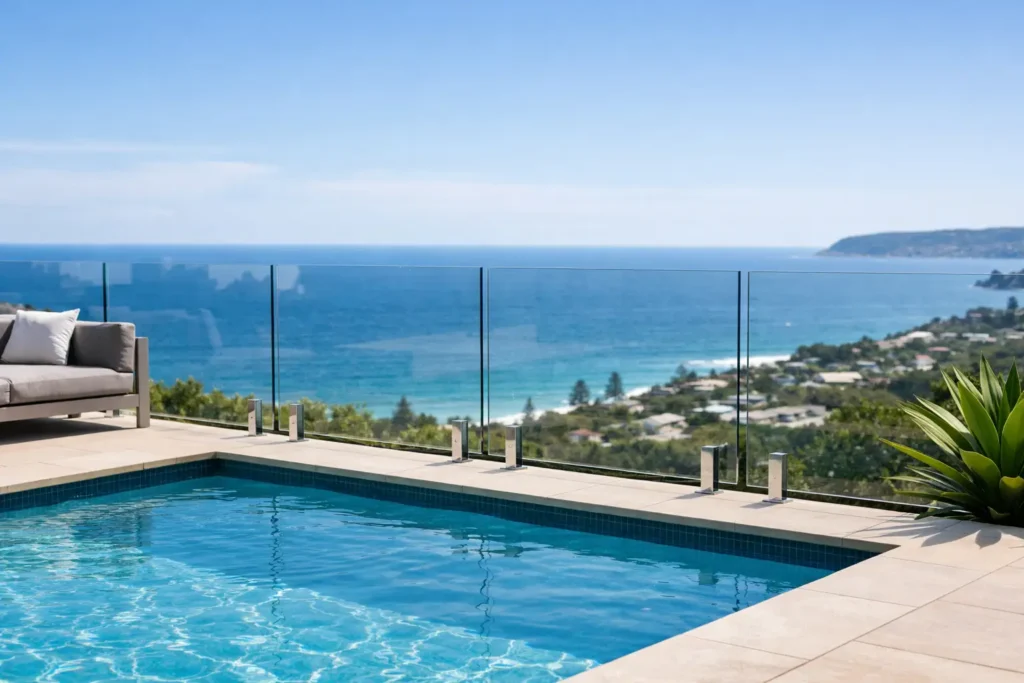
A pool fence should protect the people who use the property without turning the pool terrace into a visual barrier. That balance is why glass pool fence installation deserves the same level of planning as a custom railing, shower enclosure, or exterior glazing system. The panels may appear simple, but the finished result depends on engineering, exact field measurements, qualified hardware, and an installation team that understands how glass performs in a demanding outdoor environment.
For coastal Southern California homes, glass fencing is often selected to preserve ocean views, garden sightlines, architectural symmetry, and the open character of a terrace. It can be an exceptional solution. It is not, however, a commodity product that should be selected from a catalog and installed without careful consideration of code, substrate conditions, drainage, wind exposure, and long-term maintenance.
What a Glass Pool Fence Must Accomplish
A well-designed glass pool fence has several jobs at once. It must serve as a safety barrier, meet applicable local requirements, resist the forces placed on it, and remain visually quiet within the architecture. A system that looks nearly invisible from the living room may involve substantial work below the finished deck surface.
The first question is rarely, “What style of glass do you prefer?” It is usually, “What does this site require?” The answer is shaped by the pool location, access paths, changes in grade, existing hardscape, nearby retaining walls, gate placement, and the jurisdiction overseeing the project. A fence around a new pool may be coordinated with the landscape and structural plans from the beginning. A fence added to an existing terrace requires a closer examination of the concrete, waterproofing, embedded reinforcement, and the practical limits of the space.
Glass is especially valuable where a conventional fence would interrupt a view or make a compact pool area feel enclosed. Yet transparency also raises the standard for execution. Minor alignment errors, inconsistent panel spacing, poor gate operation, or visible hardware irregularities are immediately apparent. There are glass installers. There are glass craftsmen.
Start With the Barrier Layout, Not the Panels
The most successful installations are planned as part of the circulation of the property. Consider how a family, guests, service staff, and landscape maintenance crews move between the house and the pool. A gate should be convenient enough to use every day, but its location and operation must also support the required safety function.
A thoughtful layout accounts for the approach to the gate, latch accessibility, self-closing action, and the relationship between the fence and nearby walls, planters, furniture, equipment, and landscape features. Conditions that appear harmless on a drawing can create climbable surfaces or pinch points in the field. A qualified glazing contractor works with the project team to identify those conditions before glass is fabricated.
This is also the stage to decide whether the fence should be a primary visual feature or a restrained architectural line. Frameless systems typically use individual tempered safety-glass panels held by discreet clamps, spigots, or base-mounted channels. Some projects call for more visible posts or top rails because of structural needs, site conditions, or aesthetic preference. Neither approach is universally better. The right choice depends on the architecture, exposure, governing requirements, and desired maintenance profile.
Glass Pool Fence Installation Begins With Site Conditions
The quality of the substrate governs much of the installation. Concrete decks vary considerably in thickness, strength, reinforcement, finish, age, and condition. Natural stone, porcelain pavers, tile assemblies, waterproofed decks, and elevated terraces each require a different approach. Anchoring through a finish surface without understanding what lies beneath can compromise both appearance and performance.
Before fabrication, the installer should verify the mounting method and evaluate the deck or supporting structure. Core-drilled spigots, surface-mounted base shoes, side-mounted hardware, and engineered channel systems all place loads on the structure in different ways. On an elevated deck, coordination with the waterproofing and structural teams is particularly important. A beautiful glass fence is not a success if later water intrusion damages the assembly below it.
Coastal exposure adds another layer of consideration. Salt air, moisture, irrigation overspray, and windborne debris affect hardware finishes and glass maintenance. Premium marine-grade stainless steel hardware is frequently appropriate near the coast, but material selection should be matched to actual exposure rather than assumed. Hardware should be specified for its intended environment, and dissimilar metals should be managed correctly to reduce the risk of corrosion.
Precision Matters More With Frameless Glass
Frameless panels do not forgive casual measurement. Glass cannot be trimmed in the field. Once tempered, it must be installed as fabricated. That makes field verification essential, particularly where a fence follows curved hardscape, steps around planters, meets a stucco wall, or transitions across changing elevations.
Panel dimensions, edge clearances, gate gaps, and hardware locations must be established with precision. Fabrication should follow confirmed site conditions, not early assumptions. This is one reason custom glass work benefits from experienced project management: the team must translate a finished architectural intent into panel sizes, fixing details, tolerances, and installation sequences that work on the actual site.
Safety Glass, Hardware, and Code-Aware Coordination
Pool barrier rules are local and can change with the scope of work, property type, and jurisdiction. California requirements, municipal amendments, homeowner association standards, and project-specific architectural requirements may all influence the final design. A professional contractor does not substitute a generic online diagram for a project review.
Safety glazing is fundamental. Pool fence panels are typically fabricated from tempered safety glass, selected and sized for the system and project conditions. Depending on the design, engineered glass assemblies may be considered where additional post-breakage retention is needed. The proper glass type, thickness, edge treatment, and mounting configuration should be determined as a complete system, not as isolated components.
Gates deserve equal attention. The hinge system, closing mechanism, latch, stop, and alignment must operate reliably after repeated use and seasonal movement. A gate that drags, fails to self-close, or falls out of adjustment quickly becomes more than an inconvenience. It undermines the purpose of the barrier.
For high-end residential and hospitality work, coordination with the architect, builder, landscape architect, and local authority can prevent expensive revisions. The goal is not merely to pass an inspection. It is to create a finished enclosure that performs properly and belongs to the property.
Design Details That Separate an Ordinary Result
The most refined pool fences feel intentional from every viewing angle. Panel lines can align with paving joints, exterior door mullions, terrace edges, or key landscape axes. Hardware finish can complement window frames, handrails, or outdoor kitchen details. A carefully placed gate may preserve the principal view from an interior room rather than interrupt it.
These details are not decorative afterthoughts. They affect the visual rhythm of the entire pool environment. Large panels can reduce the number of vertical interruptions, but larger panels also require appropriate handling, access planning, and structural support. A minimal hardware approach may be ideal for an uninterrupted coastline view, while a more articulated system may better suit a traditional residence or an exposed hillside terrace.
The right answer often involves trade-offs. A fully frameless look offers exceptional clarity, but it can demand more from the existing deck. A post-supported system may provide greater flexibility for certain conditions while introducing more visible metal. The best design is the one that respects both the architecture and the realities of the site.
Protecting the Finish After Installation
Outdoor glass is exposed to mineral-rich water, salt residue, sunscreen, landscaping chemicals, dust, and airborne contaminants. Left in place, deposits can etch the surface and reduce the clarity that made glass fencing attractive in the first place. Regular cleaning with appropriate nonabrasive products and prompt removal of irrigation overspray will help preserve the panels and hardware.
For properties affected by hard water or coastal exposure, protective glass treatments can be worth considering as part of a long-term maintenance plan. Certified Diamon-Fusion® field application technology can restore qualifying damaged glass and add a permanent protective coating, offering an alternative to replacement when mineral buildup and surface deterioration have taken their toll.
Capistrano Valley Glass & Mirror has approached specialty glazing as a craft since 1979. For a pool fence, that means looking beyond the panel itself – to the structure that receives it, the hardware that holds it, the people who use the gate, and the view the glass is meant to preserve. When those elements are resolved together, the fence becomes a quiet part of the architecture rather than an interruption to it.