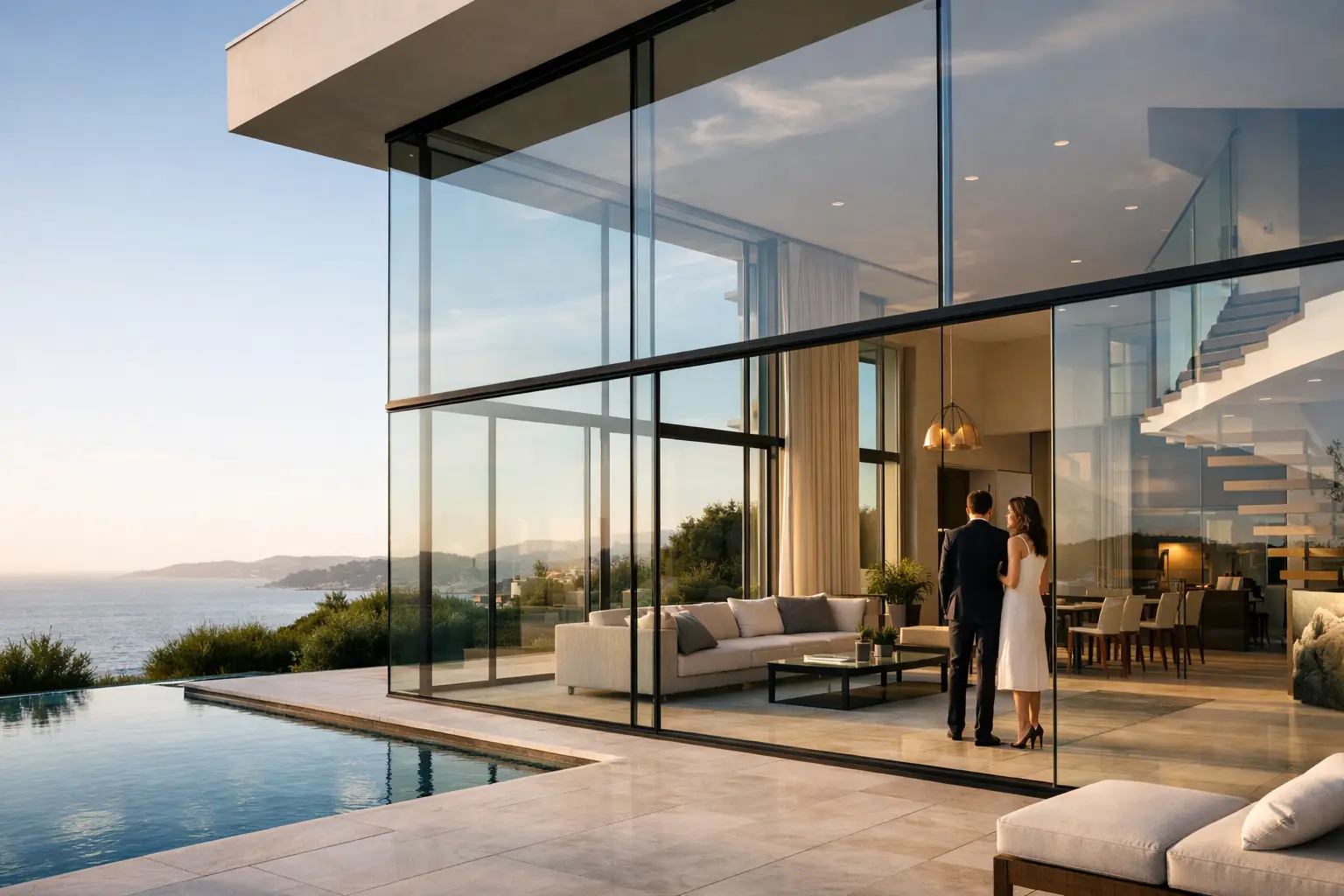

An ocean-view wall of glass can look effortless from across a room. Up close, it reveals whether the project was properly conceived: consistent reveals, clean transitions at stone and drywall, hardware that moves with quiet authority, and glass selected for the actual exposure rather than a catalog image. A luxury glazing project is not defined by square footage or a premium finish alone. It is defined by the discipline required to make a demanding architectural element look inevitable.
For homeowners, architects, and builders in coastal Southern California, that discipline matters. Salt air, intense sun, wind exposure, changing elevations, and exacting design expectations place real demands on glazing systems. The right result begins long before installation day.
A Luxury Glazing Project Starts With Architectural Intent
Glass has a rare ability to extend a view, bring daylight deeper into a plan, and reduce the visual weight of a structure. It can also expose every decision around it. A slightly uneven opening, a poorly considered drainage detail, or hardware chosen without regard for panel weight becomes immediately visible in a frameless system.
That is why specialty glazing should enter the conversation early. The glazing contractor needs to understand what the architect is asking glass to do. Is a multi-panel door system intended to frame the coastline, open a living room to a terrace, or satisfy a specific thermal and wind-load requirement? Is a stair railing meant to disappear, or is it a formal architectural guard with a prominent cap rail? Is a shower enclosure meant to feel spare and open, or to contain steam and water within a highly detailed bath?
Those questions guide glass type, thickness, edge treatment, hardware, anchoring, and tolerances. They also reveal where the design may require adjustment before materials are ordered. In high-end work, early coordination is not an added layer of process. It is how expensive revisions are avoided.
The Details That Separate Fine Glazing From Routine Installation
Luxury glasswork is often judged by what does not call attention to itself. Doors close evenly. Panels align. Hardware sits where it belongs. A mirror appears to have been built into the room rather than placed on a wall. Achieving that restraint requires technical choices that are anything but casual.
Glass selection must match the setting
Not every clear glass product performs the same way. Low-iron glass may be the right choice where visual neutrality is critical, particularly beside white stone, pale cabinetry, or carefully selected finishes. Laminated glass may be required for safety, acoustics, security, or overhead applications. Tempered glass is common in shower enclosures, railings, and doors, but thickness, dimensions, edge conditions, and fabrication details must still be engineered for the application.
Coastal projects add another consideration. Exterior glazing may need to address wind, water intrusion, solar heat, corrosion resistance, and the local code requirements that apply to a particular site. The most elegant specification is only successful if it performs through years of exposure.
Hardware is part of the architecture
Premium hardware does more than support glass. It establishes the visual language of the assembly. The finish must relate to plumbing fixtures, door hardware, metalwork, and lighting. The geometry of hinges, clamps, channels, and handles must feel proportionate to the glass and the room.
A minimal shower enclosure, for example, may call for carefully selected wall-mounted hinges and a discreet headerless configuration. Yet some conditions require additional support or a different layout to manage panel size and door swing safely. The right answer depends on the opening, the substrate, the use of the space, and the level of visual restraint the design can accommodate.
Tolerances deserve respect
Glass is fabricated to precise dimensions, but it is not field-trimmed like wood. Once a panel is tempered, alterations are not an option. Field measurements must account for walls that are not perfectly plumb, floors that carry subtle variation, tile buildup, finished stone thickness, and the movement required for doors to operate correctly.
This is especially relevant in frameless showers, glass railings, and oversized mirrors. An experienced field team reads the built condition, not merely the drawing. That distinction protects the design intent when real-world construction varies from ideal geometry.
Where Performance and Beauty Meet
The most memorable glazing projects often sit at the point where visual simplicity meets demanding performance. A glass guardrail must preserve a view while functioning as a code-conscious safety system. A skylight must introduce daylight without becoming a source of heat gain or water concerns. A large shower enclosure must retain its open character while controlling splash and supporting substantial glass.
There is no universal best solution. A completely frameless railing may be appropriate for one terrace, while a post-supported or capped system is better suited to another because of structure, budget, exposure, or jurisdictional requirements. A pivot door can create an impressive entry sequence, but it requires careful attention to floor conditions, clearances, and hardware capacity. Good glazing counsel explains these trade-offs plainly rather than forcing every project toward the same detail.
For hospitality and commercial environments, performance includes another layer: repeatable operation. Storefront systems, partition walls, bathroom mirrors, and public-area glass must withstand frequent use while retaining the finish quality expected by guests and visitors. Long-term serviceability should be considered alongside first-day appearance.
Coordination Is the Real Luxury
The finest materials cannot correct a poorly coordinated sequence. Glazing intersects with waterproofing, steel, wood framing, tile, stone, millwork, electrical, and finish painting. Each trade can affect the final fit of a glass system.
Consider a custom mirror wall with integrated sconces. The mirror fabrication depends on exact electrical locations, finished wall dimensions, outlet and switch cutouts, mounting strategy, and edge relationships to surrounding materials. If those conditions shift late, the work can become more complicated than the original concept suggested. The same is true of curved glass, where templates, radius confirmation, handling access, and lead time require disciplined planning.
This is where a showroom and an established specialty glazing partner offer practical value. Full-scale displays allow clients and design teams to assess door operation, hinge styles, channel profiles, glass clarity, and mirror treatments before finalizing a selection. That physical review often answers questions drawings cannot.
Capistrano Valley Glass & Mirror has worked from this standard since 1979, bringing family-led craftsmanship to custom residences, hospitality properties, and specialty architectural installations across Southern California. Complex work benefits from a contractor that understands both the visual ambition and the field realities behind it.
Restoration Can Protect a Significant Investment
Luxury glazing is not limited to new construction. Existing shower glass, skylights, pool fencing, and exterior panels can lose their clarity through hard-water etching, mineral buildup, corrosion, and environmental exposure. Replacement may be necessary when glass is compromised, but it is not always the first or most economical answer.
Professional restoration can remove or reduce surface damage and, when followed by a certified Diamon-Fusion® protective coating, help create a more resilient surface that is easier to maintain. The value is particularly clear in large installations where replacement would involve removal, fabrication, scheduling, and disruption to finished spaces.
Restoration is condition-dependent. Deep damage, failed insulated units, broken glass, or structural concerns may still require replacement. A careful assessment distinguishes a recoverable surface problem from a system that needs more extensive work.
Choose a Partner for the Work You Cannot Redo Easily
A luxury glazing project should be evaluated with the same care given to stone fabrication, custom millwork, or architectural metal. Review relevant project experience, licensing, fabrication capability, field measurement practices, and the team’s ability to coordinate with builders and designers. Ask how glass selections are made, how code and site conditions are addressed, and who will stand behind the finished installation.
The best glasswork does not compete with the architecture around it. It clarifies the view, honors the materials, and performs without drama. Start with the conditions that make the project distinctive, then select the glazing solution built to meet them.