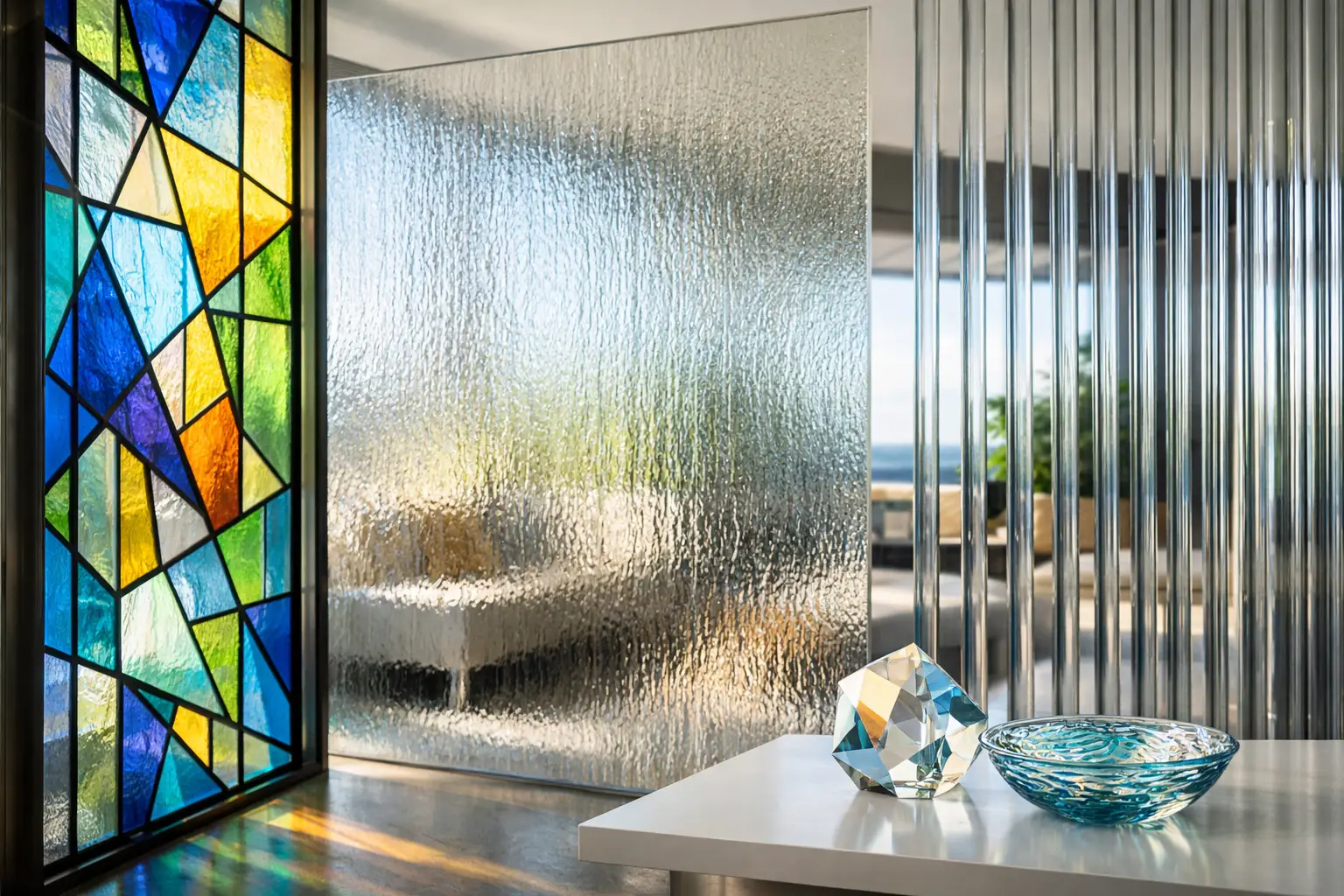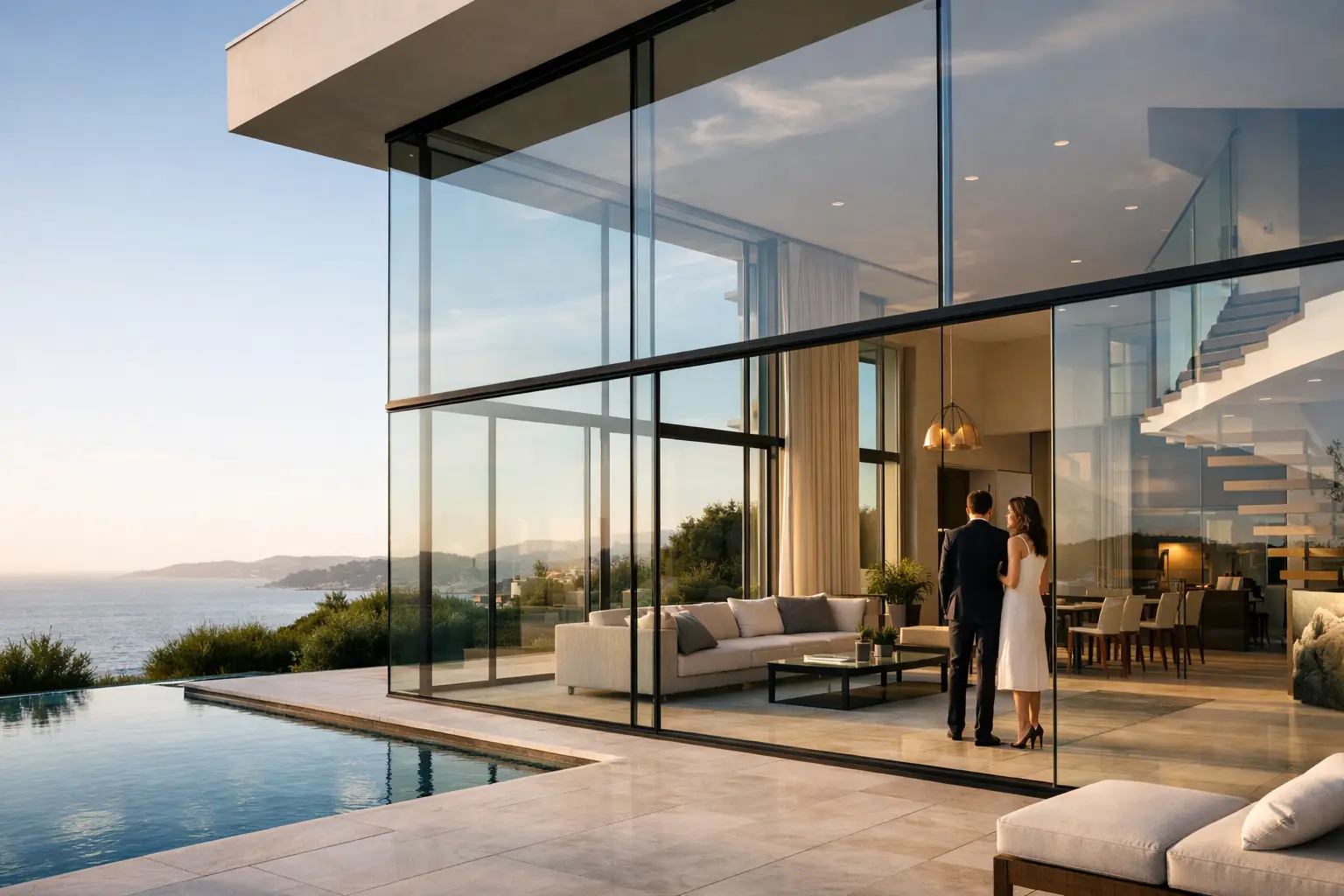
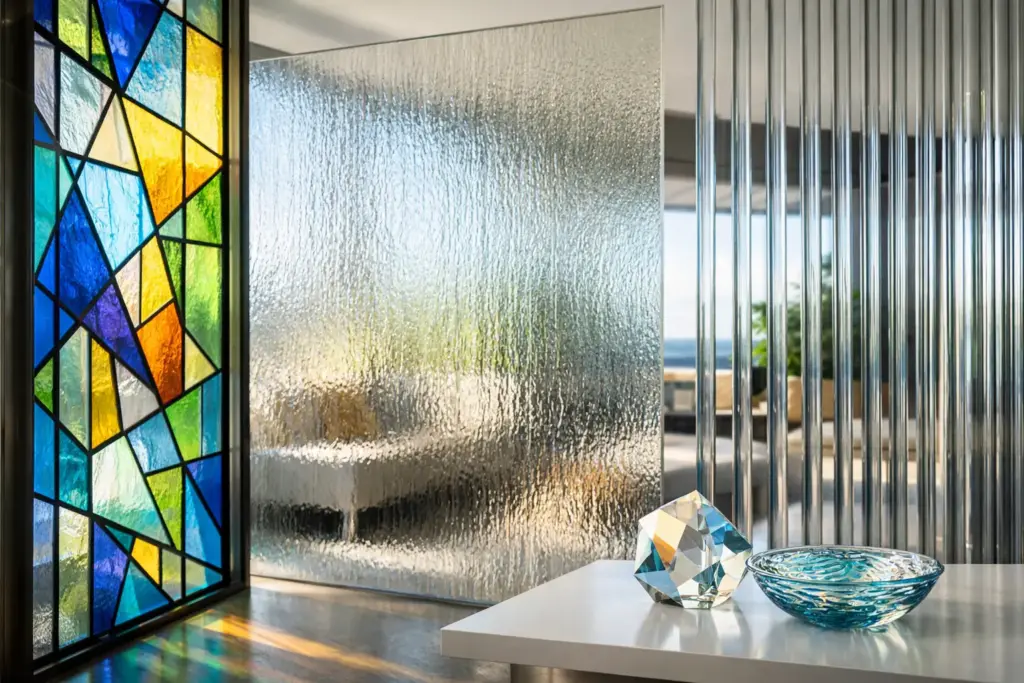
A stair hall can be flooded with light without exposing the home to a neighboring property. A primary bath can feel private without becoming opaque and enclosed. A restaurant entry can establish character before a guest reaches the host stand. Decorative glass makes these architectural moves possible, but only when its appearance, performance, and installation are considered as one decision.
For high-end homes and commercial environments, glass is not simply a transparent infill material. It controls sightlines, reflects daylight, carries pattern, softens transitions, and creates privacy at precisely the places where solid walls would make a space feel smaller. The right selection feels integral to the architecture. The wrong one can appear ornamental, dated, or poorly suited to the conditions it faces.
Decorative Glass Is More Than a Pattern
The term decorative glass covers a wide range of treatments. It may describe etched or sandblasted panels, textured glass, kiln-formed pieces, colored or laminated interlayers, antique-style glass, digitally printed surfaces, or custom art glass. Each treatment changes the way the glass transmits light and reveals what is beyond it.
That distinction matters. A clear panel with a subtle acid-etched field preserves brightness while diffusing nearby views. A deeply textured glass may produce stronger distortion and more visual movement, but can also make objects and faces harder to read through the panel. Laminated decorative glass can place a fabric, mesh, color, or graphic layer between panes, protecting the design while adding safety performance when specified correctly.
For architects and designers, the question is rarely, “Which pattern looks best?” The more useful question is, “What should this glass do from each side of the opening, at different distances, and under different light conditions?” A privacy panel that looks ideal in a showroom may reveal more than expected when backlit at night. Conversely, a dense pattern can seem overly opaque once installed in a narrow corridor with limited natural light.
Where Decorative Glass Has the Greatest Impact
In coastal Southern California homes, decorative glass is often most effective where openness and privacy must coexist. Entry sidelites, pivot doors, stair rail infill, interior partitions, wine room enclosures, and bathroom windows are natural applications. It can divide a large open-plan room without interrupting daylight, or give a shower enclosure a quieter, more tailored presence than fully clear glass.
Hospitality and commercial projects introduce different demands. Decorative glazing can distinguish a lobby, private dining room, spa, conference area, or retail facade while supporting wayfinding and brand identity. In these settings, the design must also account for frequent cleaning, high traffic, safety glazing requirements, replacement planning, and the consistency of glass across a large installation.
The most successful applications tend to be disciplined. A single patterned partition framed by clean architectural lines can carry more presence than multiple competing decorative elements. In a residence with ocean views, for example, the glass near the view should usually remain visually quiet. Decorative treatment may belong instead at a side window, interior door, or bathroom condition where it adds intimacy without competing with the landscape.
Privacy Without Losing Daylight
Privacy is often the practical reason decorative glass enters a project. Yet privacy is not absolute. It changes based on viewing angle, distance, ambient light, and the activity inside the room.
A lightly etched panel may obscure close detail but still show silhouettes. This can be ideal for an office door, wine room, or shower enclosure where lightness matters. A more obscuring texture or a layered laminated panel may be preferable for a street-facing bath window, a bedroom-adjacent opening, or a treatment room. When complete visual control is required, decorative glass may need to be combined with a secondary solution such as window coverings or an insulated wall assembly.
Mockups are valuable for this reason. Viewing a full-size sample against the intended light source and surrounding materials helps a project team judge how the glass will actually perform. Small samples are useful, but they cannot fully show the scale, reflections, edge treatment, or visual distortion of a finished panel.
Decorative Glass in Bathrooms and Wet Areas
Bathrooms place decorative glass under a different set of conditions. The panel must work with water, steam, daily cleaning, hardware, and safety requirements. Surface-applied treatments can be beautiful, but their location matters. A textured face installed toward the wet side of a shower may retain soap residue or mineral deposits more readily than a smooth surface.
For shower enclosures, the positioning of the decorative face should be resolved early. A pattern can face outward for easier cleaning inside the enclosure, while still giving the exterior the intended visual effect. Glass thickness, hinge loading, door swing, handle placement, and the continuity of the design at seams all require coordination. This is where routine installation experience is not enough. Frameless systems demand precise fabrication because the glass itself performs as the finished architectural surface.
Hard water is another consideration for coastal and inland Southern California properties. Existing shower glass, skylights, pool fencing, and exterior panels may develop mineral buildup or etching over time. In some cases, restoration and a professionally applied protective coating can be a more considered alternative to replacement, particularly when custom panels or specialty hardware are involved.
How to Specify Decorative Glass Well
The specification process should begin with function, then move to aesthetic intent. Identify whether the primary goal is privacy, daylight diffusion, visual separation, color, branding, or artwork. From there, determine the required safety glass type, panel size, edge finish, thermal conditions, and whether the glass will be insulated, laminated, tempered, or part of a fire-rated assembly.
A few decisions deserve particular attention:
- Pattern scale: Fine patterns can disappear from a distance, while bold textures can dominate a smaller room.
- Light direction: Glass viewed with daylight behind it behaves differently than glass lit from the front or back at night.
- Color matching: Colored interlayers, printed finishes, and tinted glass should be reviewed beside the actual stone, wood, metal, and paint selections.
- Edges and hardware: Polished edges, exposed clamps, channels, and custom metalwork are visible design components, not secondary details.
- Future service: Large custom panels, specialty finishes, and uncommon glass make replacement more complex. Accurate field dimensions and careful documentation have lasting value.
Not every decorative treatment belongs on every project. Highly textured glass can be difficult to clean in exterior exposure. Printed or colored glass may be unsuitable where extreme heat gain or direct ultraviolet exposure has not been evaluated. A dramatic pattern that works in a boutique hotel may feel too assertive in a restrained coastal residence. Good glazing work involves knowing where to hold back.
Why Fabrication and Installation Determine the Result
Decorative glass is frequently specified as if it were a finish layer added at the end of a project. In reality, fabrication limitations and installation tolerances should inform the design from the start. Pattern direction, artwork alignment, seam placement, cutouts, holes, and notches must be established before the glass is produced. Once tempered glass is fabricated, it cannot be cut or altered.
Large panels introduce additional complexities. They may require thicker glass, engineered support, specialized lifting equipment, or custom crating and handling. Curved or laminated decorative glass expands the design possibilities, but it also adds lead time and requires closer coordination with adjacent framing. These are not reasons to avoid ambitious work. They are reasons to involve an experienced architectural glazing contractor while the details can still be resolved properly.
Since 1979, Capistrano Valley Glass & Mirror has approached specialty glass as a material that must satisfy both visual intent and real-world performance. That perspective is especially valuable when a project calls for custom fabrication, demanding tolerances, or glass that must look as refined years after installation as it did on opening day.
Decorative glass earns its place when it gives a space something clear glass and solid walls cannot: filtered light, measured privacy, and a layer of character that remains connected to the architecture. Start with the experience you want the room to create, then let the glass be engineered and fabricated to support it.