
A clear frameless shower enclosure is meant to disappear into the architecture. When it develops cloudy marks, fine scratches, or dull areas around the door pull and lower panels, the effect is immediate: the entire bath can look less finished. Knowing how to restore scratched shower glass begins with identifying what is actually on – or in – the glass. Many surfaces that appear scratched are etched by hard water, stained by mineral deposits, or damaged by an aging protective coating.
That distinction matters. A homeowner can sometimes remove residue safely, but aggressive polishing can permanently distort tempered shower glass. The right approach protects the enclosure, the surrounding stonework, and the investment made in custom hardware and architectural glazing.
First, Determine Whether the Glass Is Actually Scratched
Shower glass is exposed to a difficult combination of water, heat, soap products, body oils, and airborne minerals. In coastal Southern California, mineral-rich water and salt-laden air can leave persistent deposits that become more visible as the glass dries. Those deposits are often mistaken for scratches.
Look at the glass under direct, raking light rather than standard overhead lighting. A true scratch usually appears as a defined line that changes with the viewing angle. If you can gently feel it with a clean fingernail, it may extend below the surface. A broad, milky area near the bottom of the panel is more often mineral etching or staining than a single scratch.
There are four common conditions worth separating before any repair work begins:
- Surface residue leaves a chalky or oily film and may improve with a professional glass-safe cleaner.
- Hard-water etching creates a hazy, dull appearance after minerals have chemically affected the surface.
- Fine abrasion often appears near handles, towel bars, or areas cleaned repeatedly with an abrasive pad.
- Deep scratching or impact damage creates lines that catch a fingernail, chips near an edge, or fractures that require professional evaluation.
A scratch is not always only a cosmetic concern. Frameless shower panels are typically tempered safety glass. While tempered glass is exceptionally strong in service, its edges and surface condition deserve careful handling. Once tempered, it cannot be cut, drilled, or materially altered like ordinary annealed glass.
How to Restore Scratched Shower Glass Safely
Start conservatively. Clean the panel with a nonabrasive, pH-appropriate glass cleaner and a clean microfiber cloth. Avoid scouring powders, green abrasive pads, razor blades, steel wool, and improvised compounds. These methods may remove visible residue, but they can also create a field of fine scratches that is more noticeable than the original problem.
If cleaning improves the surface significantly, you are likely dealing with buildup rather than physical damage. Continue with a routine that removes water after each shower, especially around the lower third of the panel where minerals accumulate. A quality squeegee used consistently is often the simplest way to preserve clarity.
When haze remains after safe cleaning, the glass may have been etched. Proper restoration can involve a controlled surface-treatment process that removes mineral damage and refines the appearance of the glass. This is specialist work, not because the concept is complicated, but because the technician must assess the type of glass, the depth and spread of damage, existing coatings, nearby finishes, and the risk of visible optical distortion.
Fine surface scratches can sometimes be reduced through professional polishing. The operative word is reduced. Polishing removes a minute amount of glass around the scratch to make it less apparent. It does not simply fill the line. On a large, highly visible shower panel, uneven polishing can create waviness or a lens-like effect that catches light from across the room. The deeper the scratch, the greater that risk.
For this reason, a reputable glazing professional should first establish whether restoration will produce a visually acceptable result. A repair that looks acceptable under work lights but distorts a view through a clear, doorless enclosure is not a premium repair.
Do Not Use DIY Scratch Kits as a Default Solution
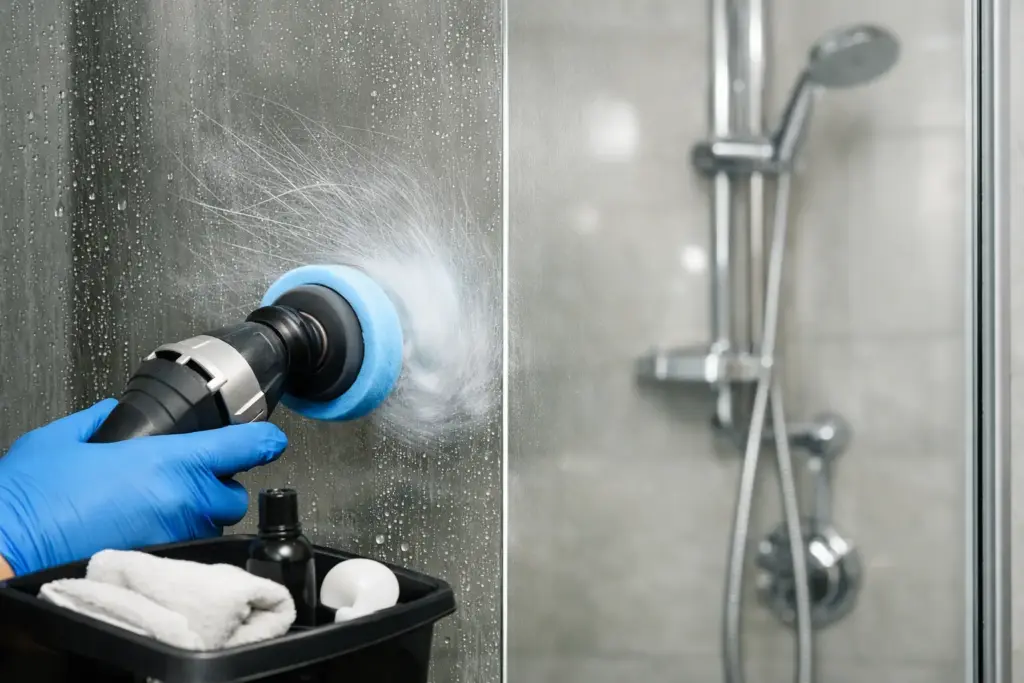
Consumer scratch-removal kits commonly rely on cerium oxide polishing compounds, abrasive pads, or drill-mounted buffing tools. They may be suitable for limited use on certain small glass items, but shower enclosures present a different standard. Large tempered panels reveal distortion easily, and inconsistent pressure can leave circular marks, heat stress, or a polished spot surrounded by duller glass.
The trade-off is straightforward: a minor scratch may remain visible, but an over-polished area can become permanently obvious. That is particularly true in bathrooms with strong natural light, backlit mirrors, dark tile, or carefully aligned stone veining.
Avoid products that promise to “erase” deep scratches in minutes. They usually either mask the defect temporarily, rely on abrasive action, or work only on superficial contamination. If the scratch catches a fingernail, expect a professional assessment rather than a quick cosmetic fix.
When Restoration and Protective Coating Make Sense
Restoration is especially valuable when the shower glass is structurally sound and the damage is primarily hard-water etching, mineral buildup, light abrasion, or surface contamination. It can preserve a custom enclosure without disrupting tile, waterproofing details, hinges, channels, or specialty hardware.
After the surface has been properly restored, a permanent protective coating can materially improve long-term maintenance. Diamon-Fusion® technology, for example, modifies the glass surface to make it more resistant to staining, corrosion, and mineral adhesion. Water still reaches the glass, of course, but it releases more readily and leaves less residue behind when the enclosure is maintained correctly.
A coating is not a concealment product. It will not fill a deep gouge or make fractured glass safe. Its value is preventive: it helps protect a restored or new surface from returning to the same condition. For homeowners who have already experienced hard-water etching, that distinction is often the difference between routine care and another costly corrective project.
Capistrano Valley Glass & Mirror provides certified Diamon-Fusion® field application as part of a specialized restoration service, allowing qualified glass surfaces to be restored and protected without automatically moving to replacement.
When Shower Glass Should Be Replaced Instead
Replacement is the better decision when scratches are deep, widespread, or concentrated in a primary sightline where polishing would risk distortion. It is also the appropriate path if there are chips near the edge, cracks, unexplained stress marks, damaged hardware holes, or corrosion that compromises the enclosure’s fit and operation.
A shower door that no longer closes cleanly, drags at the threshold, or places unusual pressure on hinges should be inspected as a system. Glass, hinges, clamps, wall conditions, and panel alignment work together. Replacing only a damaged panel may be practical, but the replacement must match the existing thickness, edgework, clearances, hardware geometry, and safety requirements.
In a high-end bath, replacement can also be an opportunity to correct an earlier compromise. Low-iron glass can improve visual clarity against white marble or pale tile. Upgraded hinges and seals can improve daily operation. A properly specified protective coating can reduce maintenance from the first day. Whether those upgrades justify replacement depends on the enclosure’s condition and the level of finish expected throughout the room.
Keep Restored Glass Clear
Once the surface is restored, gentle consistency is more effective than periodic heavy cleaning. Squeegee the glass after use, leave the enclosure ventilated until surfaces dry, and use a nonabrasive cleaner formulated for glass rather than harsh bathroom chemicals. Keep acidic or abrasive products off natural stone, metal finishes, and shower hardware as well.
If your shower glass has become cloudy, scratched, or difficult to clean, resist the urge to attack it with the strongest product in the cabinet. A careful inspection can reveal whether the enclosure needs simple maintenance, professional restoration and protection, or a precisely matched replacement – and that decision will keep the glass looking as intentional as the rest of the bath.