
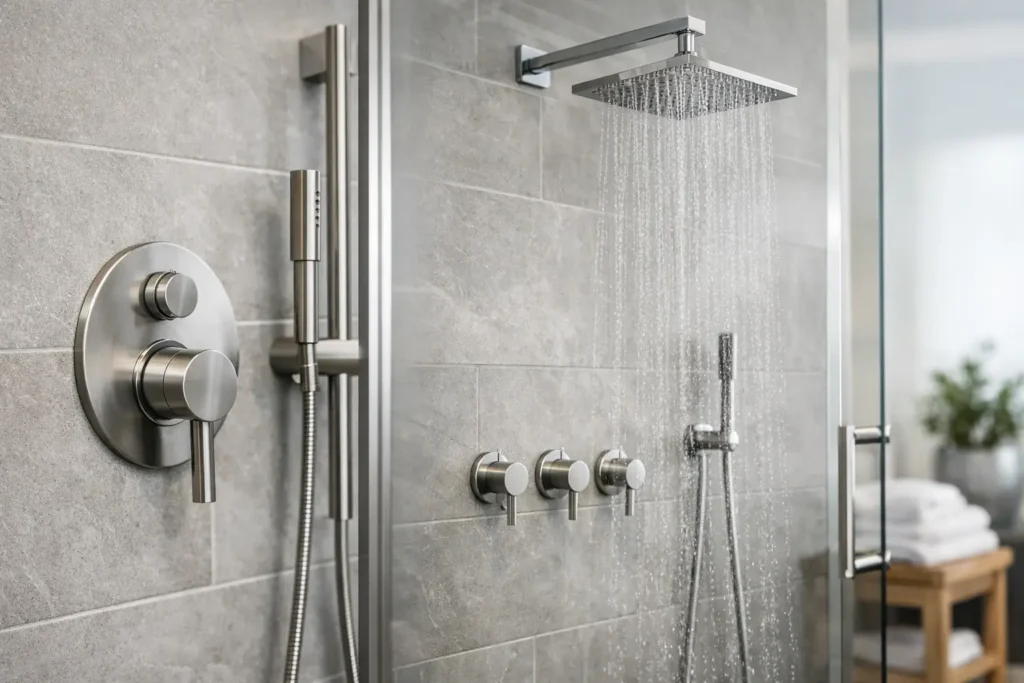
A frameless shower enclosure can appear almost effortless: clear glass, crisp reveals, and minimal metal interrupting the room. That restraint is precisely why the details matter. Knowing how to choose shower hardware means looking beyond a finish sample and selecting components engineered for the size, weight, use, and architectural character of the enclosure.
In a primary suite, the shower is opened and closed hundreds of times each year. Hardware that is under-specified, poorly aligned, or mismatched to the glass can eventually reveal itself through sagging doors, uneven gaps, corrosion, or a closing action that no longer feels precise. The right selection begins with the enclosure design, not the finish.
Start With the Shower Enclosure Design
Hardware is not a decorative add-on. Hinges, clamps, headers, channels, and handles work as a system that supports and controls heavy tempered glass. Before choosing any individual component, establish the shower layout: a single hinged door, door and fixed panel, neo-angle enclosure, sliding system, steam enclosure, or a more complex custom configuration.
A compact bathroom may benefit from a sliding door or an outswing door carefully positioned to clear a vanity and toilet. A generous walk-in shower may use a fixed panel and a door with minimal visible support. The visual result may be similar in photographs, but the hardware requirements are very different.
Door width and height are especially consequential. Larger glass doors create greater leverage at the hinge line. A taller door may also require heavier glass, additional hinges, or a different hinge series rated for the load. Avoid treating all frameless shower doors as interchangeable. A professional glazing team should calculate the actual glass weight, review hinge capacity, and determine where support is needed before glass fabrication begins.
Determine Whether the Glass Will Be Self-Supporting
Many premium frameless enclosures are designed without a header, using properly rated wall-mounted hinges and fixed-panel clamps for an open architectural appearance. This approach depends on sound wall blocking, precise glass dimensions, and hardware rated for the door weight.
In some conditions, a header, transom, or support bar is the better engineering decision. Very wide doors, tall panels, out-of-plumb existing walls, and certain steam shower designs can call for additional structure. The goal is not to eliminate every visible support at any cost. It is to use the least intrusive hardware arrangement that delivers long-term stability.
Choose Hardware for the Weight of the Glass
Most quality frameless shower enclosures use 3/8-inch or 1/2-inch tempered safety glass. Glass thickness affects visual presence, rigidity, and hardware selection. While thicker glass can create a more substantial feel and reduce panel flex, it also adds considerable weight. That added weight must be carried by hinges, clamps, fasteners, and the wall structure behind the finished tile or stone.
Hinge specifications deserve close attention. Manufacturers publish maximum door dimensions and weight ratings, but those figures are not a substitute for field judgment. Ratings assume correct installation, appropriate fasteners, sound backing, and suitable clearances. A door at the upper edge of a hinge’s stated capacity may warrant another hinge, a different hinge configuration, or a redesigned opening.
The wall connection matters as much as the hinge itself. Tile, marble, porcelain slab, and waterproof backer board are finish materials, not structural support. Hinges should be anchored into properly located solid blocking or framing. If the shower is in the planning stage, coordinate blocking with the builder before waterproofing and tile installation. If it is a renovation, the installer should verify what is behind the finished wall rather than making assumptions.
Select a Finish That Belongs in the Room
Finish is the most visible hardware decision, and it should relate to the bathroom’s other metalwork without becoming overly matched. Polished chrome remains a classic choice for its clean reflectivity and broad compatibility. Brushed nickel offers a softer, warmer appearance. Matte black creates graphic definition, while brushed brass, polished nickel, and bronze finishes can bring greater depth to a tailored bath.
The right finish depends on the surrounding materials. In a light coastal bathroom with pale stone and natural oak, brushed nickel or a restrained brass may feel appropriate. In a more contemporary bath with dark stone and sharply defined millwork, matte black can provide deliberate contrast. For a traditional setting, polished nickel often carries more visual richness than chrome.
Consistency is useful, but exact matching is not always possible or necessary. Plumbing fixtures, cabinet hardware, lighting, and shower hardware may come from different manufacturers with slightly different tones. A successful specification looks intentional across the room rather than forcing every metal surface into a perfect but unavailable match.
Also consider maintenance. Matte finishes can show soap residue in some lighting conditions, and highly polished surfaces make water spots more apparent. Coastal homes face another consideration: salt air can accelerate corrosion on inferior materials and finishes. Premium solid brass hardware with a proven protective finish generally performs better than inexpensive plated components, particularly near the ocean.
Pay Attention to the Parts You Touch Every Day
The handle is a small element with an outsized effect on the experience of the shower door. Its shape should suit the room, but it must also provide a secure, comfortable grip. A ladder pull can create a strong vertical detail on a tall door. A low-profile square pull suits modern cabinetry and linear tile. A traditional D-pull may better complement classic fixtures.
Think through where the handle will sit when the door is open. It should not strike a wall, vanity, fixture, or adjacent panel. The same applies to towel bars mounted on glass. They can be elegant and practical, but they require sufficient clearance and should never be used as a handle unless specifically designed for that purpose.
Hinge action is equally important. Quality hinges can be configured to open to a specified angle and return the door to a closed position from a controlled range. The desired swing should be established early. A door that opens outward may improve emergency access and reduce interference inside the shower, but local requirements, room geometry, and drainage details all need consideration. In many configurations, outward swing is preferred because a person who falls inside the shower is less likely to block the door.
Consider Water Management Before Fabrication
Frameless glass is designed for a clean, open appearance, not for the absolute watertightness of a fully framed system. A well-designed enclosure can manage water exceptionally well, but it needs appropriate gaps, seals, panel overlap, and showerhead placement.
The showerhead should not direct a strong spray toward the door gap or panel edge. The curb or threshold needs proper slope back toward the drain. Door sweeps and vertical seals should be selected with care: too little sealing can allow water escape, while excessive gasket material can undermine the restrained look that makes frameless glass appealing.
Steam showers require an even more detailed approach. Glass height, transom design, perimeter seals, ventilation, and hardware tolerances must work together to retain steam while allowing the enclosure to function reliably. This is a specialty condition, not simply a standard shower door with taller glass.
Specify Hardware Early in the Construction Schedule
Custom shower glass is measured after tile, stone, and finished surfaces are complete because walls are rarely perfectly plumb and openings are rarely perfectly square. Yet hardware decisions should be made much earlier. The hinge type determines blocking locations, the finish can affect lead time, and the door swing influences adjacent fixture placement.
For new construction and substantial renovations, involve the glazing contractor during design development. At Capistrano Valley Glass & Mirror, full-scale showroom displays help homeowners, designers, and builders compare hinge styles, handles, glass thicknesses, and finish combinations before those decisions become costly to change in the field.
Do Not Let Price Alone Determine the Specification
Two shower enclosures can look nearly identical on installation day and perform very differently over the next decade. Lower-cost hardware may use thinner material, less durable finish processes, limited adjustment, or components that are not intended for the actual door weight. It may also be difficult to source matching replacement parts later.
The better value is hardware selected for the specific enclosure and installed with disciplined attention to tolerances. Expect the installer to confirm glass-to-wall gaps, hinge alignment, door sweep, seal placement, and fastening conditions. A refined shower door should close predictably, maintain even reveals, and feel substantial without requiring force.
For homes with hard water, protect the investment after installation. Squeegeeing glass is still worthwhile, but protective glass treatments can reduce mineral adhesion and simplify routine cleaning. When existing glass has developed hard-water etching or stubborn mineral damage, restoration and a certified protective coating may offer an alternative to full replacement.
The most successful shower hardware selections do not call attention to themselves. They allow the glass, stone, tile, and proportion of the room to lead, while quietly doing the demanding work of supporting the enclosure every day.