A clear shower enclosure against book-matched stone, a glass guardrail framing the Pacific, or a wine-room door under carefully placed lighting can appear to have a subtle, crystalline brilliance. That raises a fair question: does low iron glass sparkle?
Yes, but not in the way a faceted crystal or decorative glass tile sparkles. Low iron glass does not contain glitter, metallic particles, or an applied shimmer. Its effect is more refined. By reducing the green cast found in conventional clear glass, it allows light, color, polished edges, and adjacent finishes to read with greater purity. Under the right conditions, that clarity can create a noticeably brighter and more luminous result.
For high-end architectural work, that distinction matters. The most successful glass installations do not rely on a single material claim. They depend on the relationship between glass selection, fabrication, hardware, lighting, setting blocks, tolerances, and the precision of the installation.
What Low Iron Glass Actually Changes
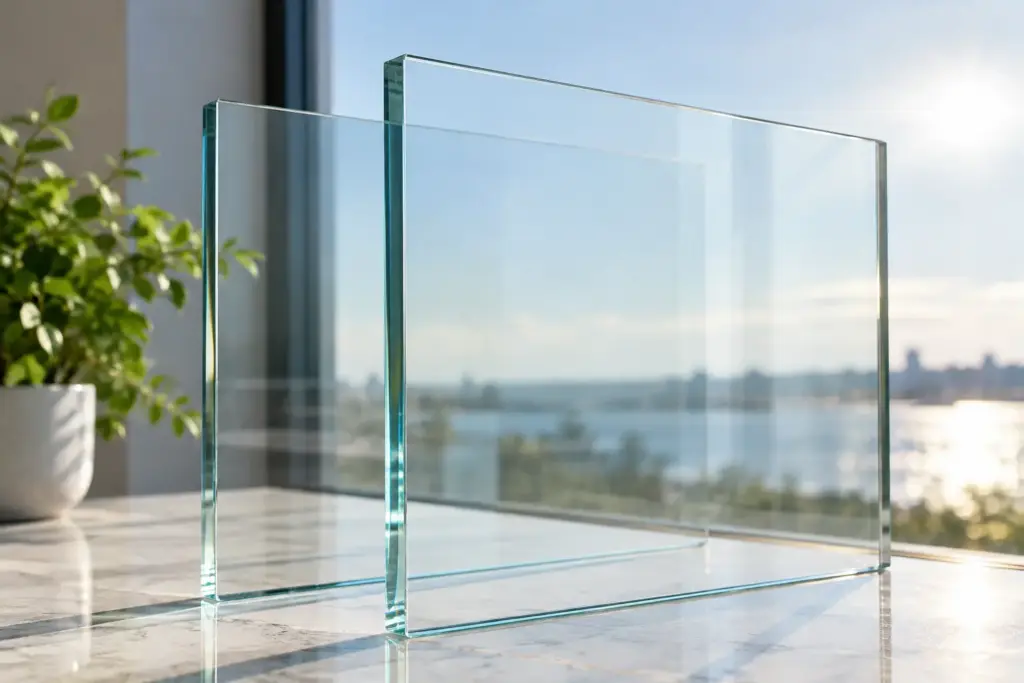
Standard clear float glass contains iron oxide, a natural component of the raw materials used to produce glass. At typical thicknesses, it often appears clear when viewed straight on. Look through its edge, however, and the familiar green tint becomes apparent. The thicker the glass, the more pronounced that tint can become.
Low iron glass is manufactured with substantially less iron content. The result is a cleaner, more neutral appearance, especially at the edge and when several layers of glass are viewed together. Whites remain whiter, pale marble and limestone retain their intended tone, and water in a pool or coastal view is less likely to take on a greenish cast through the glazing.
This is why low iron glass is often specified for frameless shower enclosures, glass railings, display cases, mirrors with glass details, interior partitions, wine rooms, and other applications where visual restraint is part of the design. It is not necessarily “invisible” glass. It is simply more faithful to the materials and light around it.
Does Low Iron Glass Sparkle in Direct Light?
Low iron glass can appear to sparkle when sunlight or focused artificial light catches a polished edge, a clean surface, or a carefully aligned corner. The effect comes from reflection and refraction, not from the low iron composition alone.
A highly polished edge is particularly important. In conventional glass, the green edge can absorb attention and read as a colored line. In low iron glass, that edge is clearer and more reflective. On a thick frameless shower panel or a substantial glass stair guard, it can create a bright, crisp line that changes as the viewer moves through the room.
Direct sunlight may intensify that effect, particularly in a coastal Southern California residence where large openings bring in strong, angled afternoon light. Yet direct sun is not required. A well-designed lighting plan can create the same sense of luminosity. Concealed LED lighting, a pendant placed near a glass partition, or warm grazing light across polished stone can all give low iron glass a quiet brilliance.
There is a trade-off. More reflected light can also reveal fingerprints, water spotting, and surface residue. A sparkling presentation depends on genuinely clean glass. In a shower, hard-water minerals can quickly dull even the finest low iron panel if the surface is not protected and maintained.
Why the Edge Often Makes the Difference
When clients describe glass as having “sparkle,” they are frequently responding to the edge rather than the face of the panel. Thickness, edgework, and geometry all influence what they see.
A 1/2-inch low iron shower enclosure, for example, has a more substantial exposed edge than a thinner interior partition. If that edge is polished to a high standard, it can carry light through the panel and produce a jewel-like clarity without looking ornamental. Mitered glass corners and precisely aligned notches can heighten the effect further, provided fabrication and installation tolerances are controlled.
The same principle applies to low iron laminated glass railings. The exposed top edge can look remarkably clean against an ocean horizon or a pale stone terrace. But the interlayer, glass thickness, structural attachment method, and local code requirements must all be considered. A visually elegant guardrail is still a safety-critical architectural system.
Where Low Iron Glass Has the Greatest Visual Value
Low iron glass is most compelling where conventional glass would compete with a carefully selected finish. In a white marble bath, a standard clear-glass enclosure may introduce a faint green veil at the edges. Against warm plaster, light oak, or creamy porcelain, the difference may be less dramatic but still perceptible to a trained eye.
It also performs well where layers of glass overlap. Corner shower enclosures, multi-panel doors, stacked shelves, and certain railing conditions can make the green cast of standard glass more visible. In these applications, low iron glass helps preserve the clean, open quality the design intends.
For exterior-facing installations, expectations should be realistic. Low iron glass improves color neutrality, but it does not eliminate reflections, glare, or the visual presence of glass itself. A west-facing railing in full sun will reflect sky, landscaping, and interior lighting differently throughout the day. That changing reflection is part of its character, not a fabrication defect.
The Details That Create a Luminous Result
Glass quality establishes the starting point. The finished appearance is decided by the entire system.
First, consider the surrounding palette. Low iron glass earns its place most clearly near white, pale, or color-sensitive finishes. It may be less necessary when the design intentionally uses darker stone, bronze hardware, smoked glass, or a warmer, more layered aesthetic.
Second, specify edgework with the same care given to the glass itself. Seamed edges are appropriate where edges are concealed, but exposed edges generally call for polished finishing. Corners, cutouts, holes, and hinge locations should be fabricated for the exact hardware and field conditions rather than adjusted casually during installation.
Third, treat hardware as a visual element. Minimal clamps, clean channel systems, and well-proportioned hinges allow the clarity of the glass to lead. Hardware that is too heavy, poorly aligned, or visibly improvised can diminish the effect of premium glass immediately.
Finally, plan for maintenance from the beginning. In shower environments, a certified protective treatment such as Diamon-Fusion® can help reduce the adhesion of mineral deposits and make routine cleaning more manageable. It does not make glass maintenance-free, but it can help preserve the clarity that justified the low iron upgrade in the first place.
Low Iron Glass Is Not Always the Right Specification
Low iron glass is a premium choice, and it should be selected because the project will benefit from it, not because it is automatically superior in every application. Conventional clear glass can be entirely appropriate for utility spaces, darker design schemes, concealed-edge conditions, or projects where budget must be directed toward structural upgrades, specialty hardware, or larger panel sizes.
It is also worth separating low iron glass from specialty decorative glass. If the goal is a pronounced sparkle, privacy, texture, or light diffusion, a patterned, cast, etched, back-painted, or laminated decorative glass may be the more direct solution. Low iron glass is best when the desired effect is purity and restrained brilliance.
At Capistrano Valley Glass & Mirror, that evaluation begins with the actual setting: the stone sample, tile color, opening dimensions, hardware finish, sightlines, and light that will meet the completed work. For a custom residence or hospitality environment, those details are not secondary. They are the work.
A small sample can help confirm color, but it cannot fully predict the presence of a finished 10-foot panel in a sunlit room. Review the glass at the intended thickness, against the intended materials, and in lighting that resembles the completed space. When the glass is specified as part of the architecture rather than an afterthought, low iron glass can deliver the clear, luminous finish that makes a room feel more resolved.