A mirror can appear perfect at installation, then develop dark edges, cloudy corners, or black speckling years later. For homeowners asking how to prevent mirror desilvering, the answer begins behind the glass. Most failures are not caused by the reflective face itself, but by moisture, chemicals, and installation details that allow the mirror backing to corrode.
In a finely finished bathroom, dressing area, bar, or coastal residence, mirror deterioration can make an otherwise exceptional room feel neglected. Prevention is largely a matter of specifying the right product, controlling humidity, and treating the mirror as precision architectural glass rather than a disposable surface.
What Mirror Desilvering Actually Is
A conventional mirror is made by applying a reflective metal coating to the back of clear glass, then protecting that coating with one or more paint layers. The visible reflection depends on those rear layers remaining intact. When moisture reaches the coating through an exposed edge, damaged backing, or failed installation condition, oxidation begins. The result is often called desilvering, although modern mirrors may use aluminum or other reflective materials as part of their construction.
The familiar signs are black or brown spots around the perimeter, a darkened band at the bottom edge, or irregular areas where the reflection has lost its clarity. In bathrooms, deterioration often starts near a vanity backsplash or at lower corners where water collects. In coastal Southern California, airborne salt and persistent humidity can accelerate the process, particularly in homes that are opened to ocean air.
Desilvering should not be confused with surface haze, hard-water spotting, or scratches on the front face. Those conditions affect light passing through the glass surface and may be treatable through professional restoration methods. Desilvering is a backing failure. Once the reflective layer has corroded extensively, replacement is generally the proper remedy.
How to Prevent Mirror Desilvering Through Better Design
The most successful prevention happens before the mirror is cut. A bathroom mirror should be designed in relation to the room’s ventilation, wall finish, plumbing locations, and daily use. This matters most for large wall-to-wall mirrors, mirrors installed directly above wet vanities, and custom pieces integrated with lighting or cabinetry.
Specify a mirror suited to humid conditions
Not every mirror product is equally appropriate for every environment. Standard mirror can perform well in dry living spaces, while high-humidity bathrooms, spas, pool houses, and coastal properties may justify upgraded protective backing or copper-free mirror products. Copper-free mirrors are designed to reduce corrosion risk by eliminating one traditional component that can contribute to edge deterioration.
The right specification depends on the installation. A powder room used occasionally has different demands than a primary bath with a steam shower, double vanity, and limited natural ventilation. For a large custom installation, a glazing professional can help match the mirror type, edge treatment, and mounting method to actual site conditions rather than relying on a one-size-fits-all selection.
Keep water away from exposed edges
Mirror edges are vulnerable because they provide a path for moisture to reach the protective backing. The lower edge is particularly exposed when a mirror sits directly on a stone countertop, tile ledge, or backsplash where standing water is common.
A small, intentional clearance between the mirror and countertop can make a meaningful difference. That gap allows the area to dry rather than trapping water against the mirror edge. Where a sealant joint is appropriate, it should be selected and applied carefully. Sealant is not a substitute for proper spacing and ventilation, and some products can damage mirror backing if they are chemically incompatible.
Avoid running a bead of generic adhesive or caulk across the back of a mirror without confirming that it is mirror-safe. Certain adhesives release compounds during curing that can stain or attack the reflective coating from behind. Precision mirror work requires materials chosen specifically for glass and mirror applications.
Do not trap the mirror against a damp wall
Moisture does not only come from the front. An exterior wall, plumbing leak, poorly sealed shower wall, or intermittently damp substrate can introduce moisture from behind the installation. A mirror mounted over an unresolved wall condition may show deterioration even when it is cleaned correctly.
For larger architectural mirrors, installers should assess wall flatness, substrate condition, fastening locations, and air circulation behind the glass. Mechanical clips, concealed channels, and approved mirror mastic each have a place, but the method should suit the mirror size and wall assembly. A clean-looking installation that traps moisture can become an expensive replacement project later.
Control Humidity Before It Reaches the Mirror
Ventilation is the most practical long-term defense in a bathroom. Running an appropriately sized exhaust fan during bathing and for a period afterward reduces condensation on mirrors, walls, and cabinetry. If a mirror remains fogged long after a shower, the room is signaling that its moisture load exceeds its ventilation performance.
For a primary suite or luxury bath, consider the complete environment: shower enclosure design, ceiling height, operable windows, fan capacity, and whether a steam shower is present. Steam showers deserve particular attention because they create sustained heat and moisture beyond normal bathing conditions. A properly detailed steam enclosure and dedicated ventilation strategy protect much more than the mirror.
Heated mirror pads can be worthwhile in some applications. They reduce condensation by warming the glass surface, which improves daily usability and limits repeated wetting. They do not correct poor ventilation or protect a mirror from moisture entering through the edges or back, but they can be a sensible component of a well-designed bathroom.
Clean Mirrors Without Damaging the Backing
The wrong cleaning routine can turn a manageable moisture issue into recurring edge damage. The common mistake is spraying cleaner directly onto the mirror. Excess liquid runs down the face, collects at the lower edge, and can work into the backing over time.
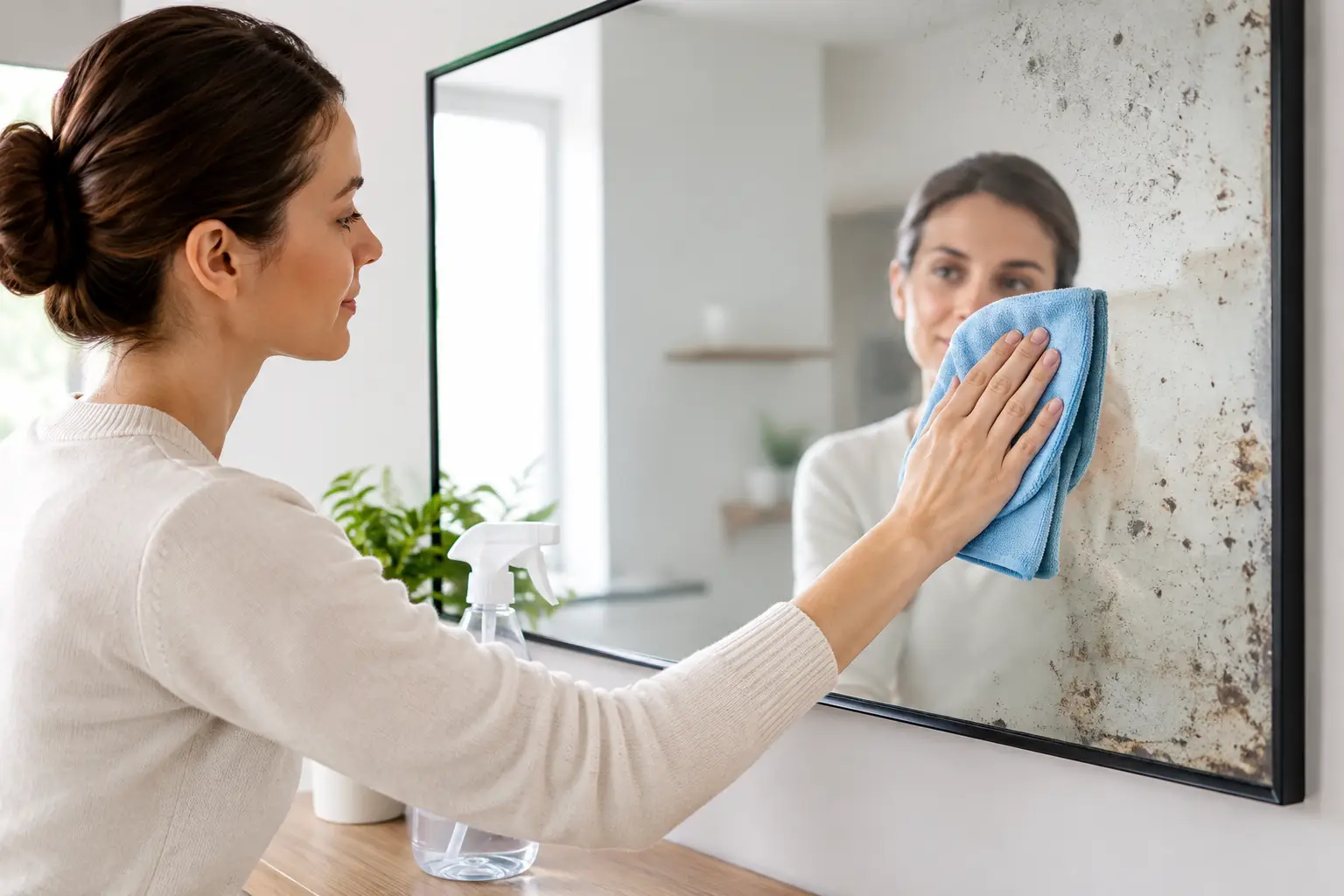
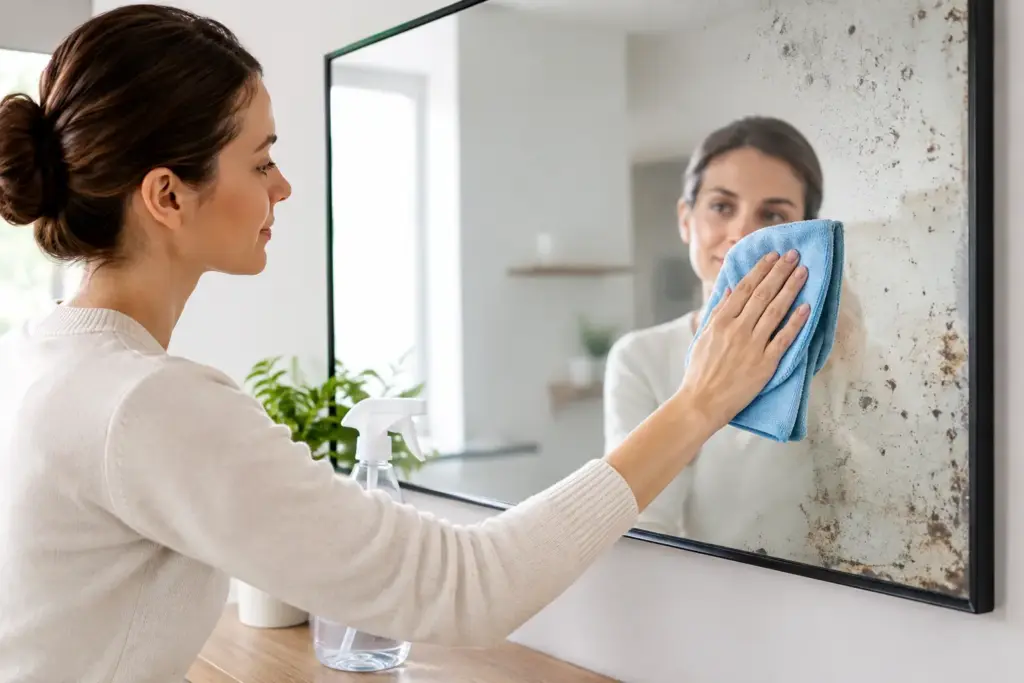
Spray a small amount of cleaner onto a clean microfiber cloth instead, then wipe the glass without soaking it. Follow with a dry section of the cloth to remove residual moisture. A mild, nonabrasive glass cleaner is usually sufficient for regular care.
Avoid abrasive pads, powdered cleaners, and aggressive acidic products. Do not use a razor blade to remove residue unless a glass professional has confirmed it is appropriate for that specific mirror. Scratches, edge chips, and damage to the rear coating can shorten the service life of an otherwise sound piece.
Pay special attention to cosmetic products around vanity areas. Hair spray, perfume, acidic skin-care products, and aerosol cleaners can settle along mirror edges and leave residues. Wipe splashes promptly, especially near the bottom edge and around integrated lighting details.
Address Small Problems Before They Spread
Early edge discoloration is a reason to investigate, not simply to clean more aggressively. Look for a failed caulk joint, water collecting behind a faucet, a leaking light fixture, persistent condensation, or a damp wall. Correcting the source may preserve the rest of the installation and prevent the same problem from recurring after replacement.
A small desilvered area cannot be restored to a true reflective finish with touch-up paint. Temporary cosmetic repairs may disguise a narrow edge in limited situations, but they rarely match the optical quality of the original mirror. For a custom vanity mirror or full-height architectural installation, replacement is often the cleaner long-term decision once deterioration becomes visible.
Before replacing it, document where the failure began. If the damage is concentrated at the bottom, water exposure at the countertop is likely. If it appears broadly across the perimeter, humidity, incompatible adhesive, or a compromised backing may be involved. This diagnosis informs a better replacement specification.
When Professional Mirror Work Is Worth It
Large-format mirrors, beveled edges, antiqued finishes, safety-backed mirror, integrated sconces, and mirrors cut around stone, cabinetry, or plumbing are not routine installations. They require accurate field measurements, careful fabrication, and a mounting approach that protects both the glass and the finish behind it.
Capistrano Valley Glass & Mirror approaches these installations as architectural glazing work, particularly where premium materials and long-term performance are expected. The difference is often found in details that are invisible on day one: compatible adhesives, protected edges, sound wall preparation, exact clearances, and clean coordination with tile, stone, electrical, and millwork trades.
For properties near the coast, the best preventive measure is not excessive cleaning or a thicker bead of sealant. It is a mirror installation designed to dry, ventilate, and remain protected at every edge. That standard preserves the reflection guests see and the craftsmanship homeowners intended the room to carry for years.