A panoramic wall of glass can frame the Pacific, flood a great room with morning light, and make an ocean-view home feel inseparable from its setting. It can also become the source of uncomfortable heat, fading finishes, exterior noise, and persistent condensation if the glass assembly is specified as an afterthought. Insulated glass units are the concealed performance layer behind many of Southern California’s most successful window walls, exterior doors, skylights, and fixed architectural glazing.
For a custom residence, hotel, or hospitality renovation, the question is rarely whether insulated glazing is warranted. The more consequential question is which glass build-up will meet the design intent without compromising clarity, color, safety, thermal comfort, or the detailing of the surrounding system.
What insulated glass units actually do
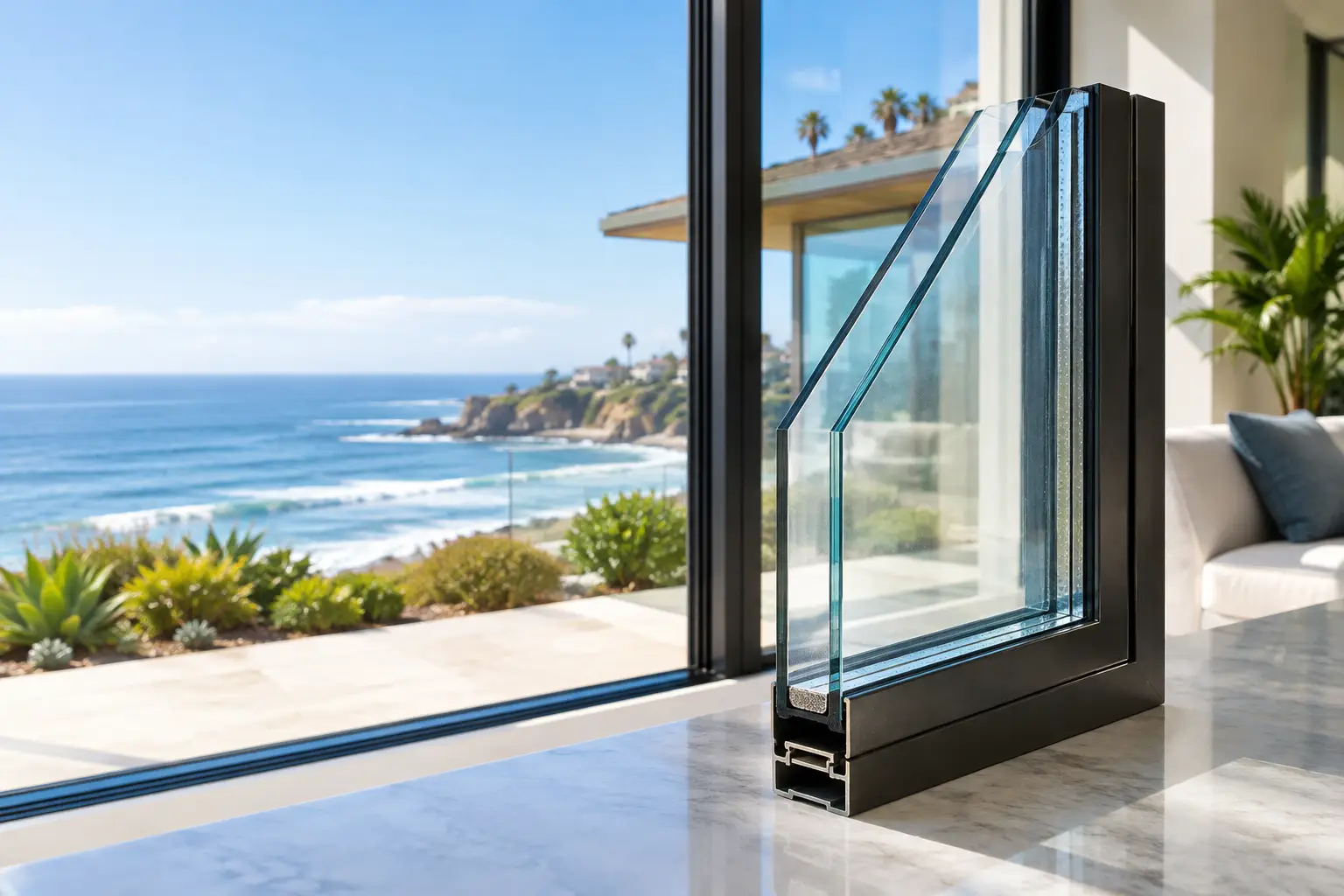
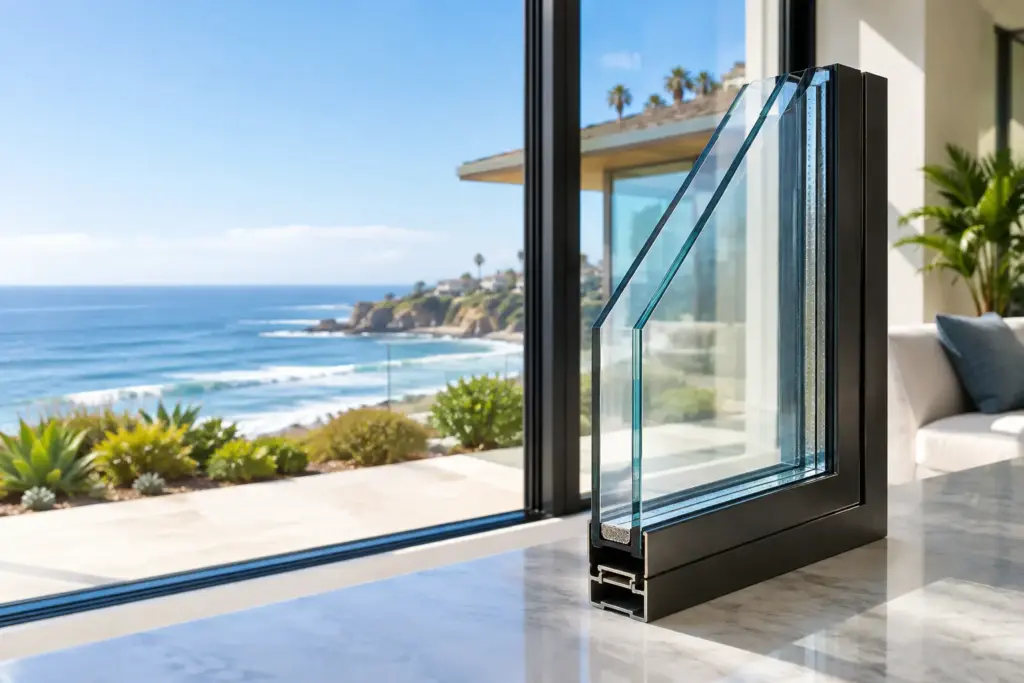
An insulated glass unit, often called an IGU, consists of two or more panes of glass separated by a sealed airspace. The space is typically filled with dry air or an inert gas such as argon. A perimeter spacer maintains the separation, while primary and secondary seals protect the cavity from moisture intrusion.
That assembly interrupts heat transfer far more effectively than a single pane. In practical terms, it helps keep solar heat outside when it is unwelcome, limits indoor heat loss during cool evenings, and reduces the likelihood of interior condensation. It can also improve acoustic comfort, although sound control depends on the complete glass configuration rather than insulation alone.
The value is especially apparent in expansive glazed openings. A large pivot door facing west, a multi-panel sliding door along a terrace, or a skylight above a stair hall places a great deal of glass between conditioned interiors and the exterior environment. The performance of that glass affects the room every day, not only during an extreme weather event.
Insulated glass units are not a single specification
Two units may look nearly identical from several feet away yet perform very differently. Glass thickness, airspace depth, coating position, tint, spacer type, laminated interlayers, and gas fill all influence the outcome. That is why a generic request for “dual-pane glass” is not enough for a high-value project.
Solar control without a dark, reflective appearance
Southern California projects often need strong solar management, particularly on west and south exposures. Low-emissivity coatings are central to that calculation. A carefully chosen low-E coating can reduce solar heat gain while preserving a bright, neutral view. The correct choice depends on orientation, shading, local climate, interior finishes, and the amount of visible light the architecture requires.
Too much solar control can make glass appear noticeably gray, blue, green, or reflective. Too little can leave a beautiful room difficult to occupy in late afternoon. Coastal homes present another consideration: low-angle sun and highly reflective water can create glare even where exterior temperatures remain moderate. A glazing professional should evaluate the glass in relation to the actual exposure, not simply apply the same specification to every elevation.
Thermal performance and edge conditions
The center of a glass pane is only part of the story. Heat can move more readily around the perimeter of an IGU, where the spacer and seal are located. Warm-edge spacer systems can improve edge performance and reduce the risk of condensation near the frame.
Frames, door stiles, sill conditions, and installation details matter as much as the glass unit. A high-performance IGU placed in an inadequately detailed system cannot deliver its full potential. For custom steel windows, oversized doors, curtain wall, and specialty glazing, the performance discussion must include the complete assembly.
Safety, security, and acoustic control
Tempered glass may be required at doors, low-level glazing, wet areas, and other hazardous locations. Laminated glass can provide a measure of post-breakage retention, UV filtering, and enhanced sound control. It is often selected for oceanfront homes, skylights, rail-adjacent glass, and locations where safety or security requirements are more demanding.
When quiet is a priority, glass asymmetry can be more effective than simply adding panes. Combining different glass thicknesses, or using a laminated lite with an acoustic interlayer, can reduce a broader range of sound frequencies. This is useful near active roads, resort activity areas, or properties exposed to surf, wind, and neighborhood noise. The trade-off is additional weight, cost, and sometimes a different visual appearance at the glass edge.
The coastal environment adds complexity
Salt air, strong sun, wind-driven moisture, and hard-water exposure make coastal glazing less forgiving. Insulated glass units themselves are sealed, but their long-term performance relies on compatible framing, proper glazing methods, drainage, and sealant work. Water that is trapped in a system or repeatedly driven into unprotected joints will eventually test even premium materials.
Large openings also move. Frames expand, contract, deflect under wind load, and respond to building settlement. Glass must be sized, supported, and glazed to allow for those realities. A beautiful wall of glass is not successful if it binds under movement, develops seal failure, or places stress at corners and edges.
For homes close to the coast, material selection deserves particular care. Hardware, fasteners, glazing pockets, and surrounding finishes should be coordinated for the environment rather than selected independently. The goal is not merely to install a glass unit that performs on paper. It is to create an assembly that remains composed after years of sun, salt, cleaning, and daily operation.
When clarity matters as much as performance
Architects and homeowners are often rightly concerned that high-performance glazing will compromise the view. In a residence overlooking Laguna Beach, Dana Point, Newport Harbor, or the hills of San Juan Capistrano, color neutrality and low visual distortion are not minor preferences. They are part of the architectural experience.
This is where glass samples and full-size displays are valuable. A small sample can show tint, reflectivity, and coating character, but a larger viewing area reveals how the glass behaves against sky, foliage, water, and interior finishes. It also makes differences in edge quality, reflection, and visual flatness more apparent.
For specialty projects, the decision may involve more than a standard rectangular unit. Curved insulated glass, oversized panels, decorative interlayers, bird-safe patterns, and custom shapes require early coordination. Fabrication tolerances, lead times, panel handling, and engineering requirements all become more significant as the glass becomes more ambitious.
Recognizing insulated glass unit failure
A properly fabricated IGU should keep its internal cavity dry. When its perimeter seal fails, moisture can enter the airspace and cause fogging, haze, or mineral-like deposits between the panes. Because the damage is inside the unit, exterior cleaning cannot correct it.
Not every cloudy surface means the unit has failed. Hard-water spotting, construction debris, surface corrosion, and weathering can affect exterior glass and may be addressable through professional restoration. A close inspection distinguishes surface damage from an internal seal failure before replacement is prescribed.
This distinction can save owners substantial cost. Where the glass surface is the problem, certified restoration and protective treatment may preserve existing panels and improve future cleanability. Where moisture is trapped between panes, the insulated unit generally requires replacement because its sealed cavity has been compromised.
Why installation quality protects the investment
Insulated glass units are precision products, but their field performance depends on exact installation. Glass setting blocks must be correctly placed. Clearances must accommodate movement. Glazing gaskets and sealants must be compatible with the system and applied with care. Exterior drainage paths must remain open.
These details are easy to overlook until a problem appears: a door panel that drags, water intrusion at a sill, recurring condensation, unexplained cracking, or a premature seal failure. Correcting those conditions after interior finishes and exterior cladding are complete is far more difficult than addressing them during design and installation.
Capistrano Valley Glass & Mirror approaches architectural glazing as a coordinated craft, particularly where oversized, custom, curved, or technically demanding glass is involved. For owners and project teams, that means resolving the glass specification alongside the frame system, structure, waterproofing, and final visual standard rather than treating it as a commodity purchase.
Questions worth answering before glass is ordered
Before approving an insulated glass package, confirm the orientation and shading of each elevation, the desired level of solar control, applicable safety requirements, expected wind loads, and whether noise reduction or privacy is a priority. Review the appearance of the chosen glass in daylight, including its tint and reflectivity from both sides.
Also consider maintenance. Exterior shower-adjacent windows, pool fencing near glazed doors, skylights, and coastal exposures may need a more deliberate cleaning and protection plan than sheltered interior glass. Protective coatings can reduce mineral adhesion and simplify maintenance, but they do not replace proper drainage, compatible materials, or disciplined care.
The best insulated glass unit is not necessarily the one with the most layers or the highest published performance number. It is the one selected for the opening, exposure, architecture, and life of the property. When glass is carrying the view, shaping the light, and protecting the comfort of the home, those decisions deserve the same precision as the architecture around it.