
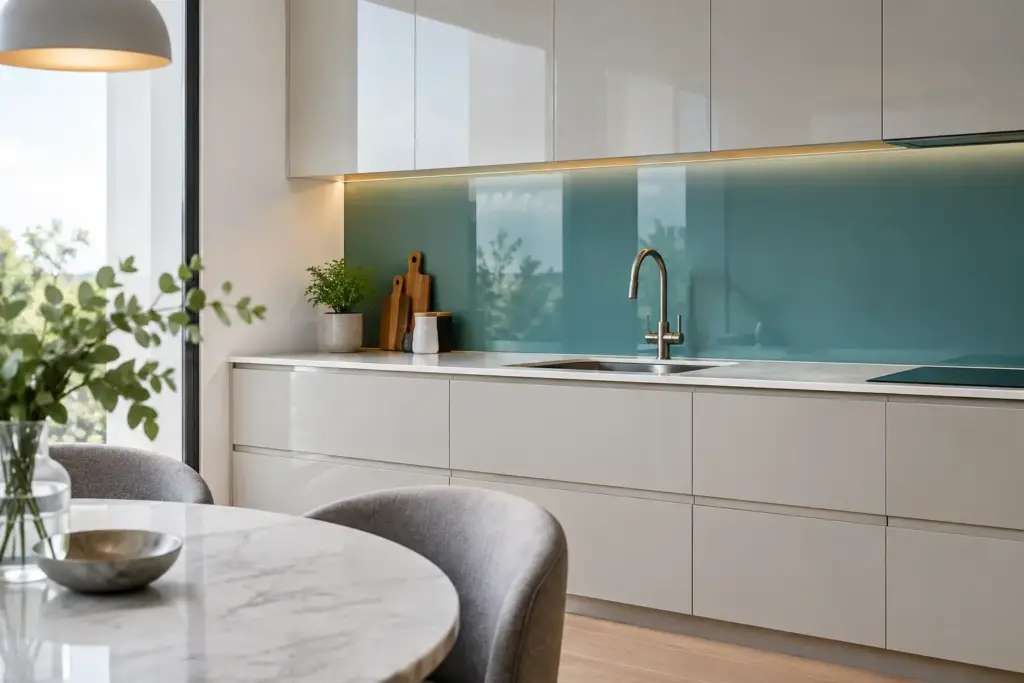
A wall color can be adjusted after move-in. A back-painted glass backsplash or wall panel is a fabricated architectural finish, measured to the room, cut for every outlet and penetration, and installed as a permanent visual plane. This back painted glass guide addresses the decisions that determine whether the finished work reads as crisp and tailored or merely colorful.
Back-painted glass is especially compelling in coastal Southern California interiors, where daylight, ocean views, and restrained material palettes place a premium on clean reflection. Used well, it can create a continuous field of color behind a kitchen range, across a bar wall, within a powder room, or around a reception area without the grout lines, texture, or visual interruption of tile.
What Back-Painted Glass Is
Back-painted glass is glass with a durable color coating applied to its reverse side. The glass face remains exposed, creating depth and a polished surface while protecting the paint layer behind it. It is commonly specified as a backsplash, feature wall cladding, cabinet insert, elevator surround, or decorative panel in hospitality and commercial interiors.
The distinction matters because the paint is not applied like ordinary wall paint after installation. Color, glass selection, edge finish, safety treatment, holes, cutouts, and mounting method must be resolved before fabrication. Once glass is tempered, it cannot be cut, drilled, or reshaped.
For premium work, the panel is not simply a piece of glass painted to match a swatch. It is an assembled specification. The appearance depends on the glass itself, the coating system, the substrate behind the panel, the lighting in the room, and the precision of the finished edges and joints.
Choosing Glass and Color With Intention
Clear float glass has a natural green cast that becomes more visible at exposed edges and can influence pale colors. For bright whites, soft grays, light blues, blush tones, and other nuanced finishes, low-iron glass is often the better choice. It presents color more faithfully and gives the panel edge a clearer, more refined appearance.
That does not mean low-iron glass is required for every application. Deep charcoal, navy, black, saturated green, and many warm dark colors can perform beautifully on standard clear glass, particularly when the edge is concealed. The right selection depends on the desired color accuracy, panel thickness, lighting conditions, and budget.
Color should be reviewed in the actual project environment whenever possible. A warm white that looks composed in a showroom may appear cooler beside Calacatta marble, walnut cabinetry, or strong north-facing daylight. Conversely, a color selected under warm interior lighting can look unexpectedly vivid in a sun-filled kitchen overlooking the coast.
For custom colors, provide a physical reference whenever available: a paint chip, cabinet sample, stone sample, or approved control sample. Digital renderings and phone photographs are useful for direction, but they are not color standards. The glass face adds reflectivity, which can make a color appear deeper or more luminous than the same coating on drywall.
Gloss, Matte, and Reflection
Standard back-painted glass has a glossy face. Its reflections can enlarge a compact kitchen, carry light across a darker hallway, and give a bar or vanity wall an unusually clean finish. In a room with broad windows or strong point lighting, those same reflections should be anticipated rather than treated as a surprise.
A matte or satin glass face offers a quieter expression and can reduce visible reflections. It is not automatically lower maintenance, however. Some satin surfaces show fingerprints, smudges, or directional cleaning marks more readily than polished glass. Review a full-size sample under project lighting before committing to either finish.
Where Back-Painted Glass Performs Best
Kitchens remain the most familiar application. A single panel behind a range or along a countertop creates an uninterrupted backsplash that is easy to wipe clean. Long runs can be divided at intentional locations, such as a cabinet break or corner, rather than forcing joints into the most visible portion of the wall.
In bathrooms, back-painted glass can replace a conventional backsplash behind a floating vanity or form a distinctive accent wall outside the direct spray zone. It works particularly well with precision mirror work, stone countertops, and streamlined plumbing fixtures. For a wet-area installation, the glazing contractor should evaluate edge protection, substrate condition, sealant compatibility, and how water will be managed at every termination.
The material also suits settings where architectural restraint carries more weight than ornament. A concealed-service bar, fireplace surround outside the heat zone, reception wall, or boutique retail display can gain color and depth without adding visual clutter. In hospitality work, glass panels can be specified to coordinate with millwork and withstand frequent cleaning, provided the installation detail is designed for the setting.
Back-painted glass is not the first answer for every surface. It may be less appropriate where a heavily textured, handmade appearance is central to the design, where numerous field adjustments are expected, or where exterior exposure could compromise the coating system. A specialty glazing professional should also confirm whether heat, impact requirements, and local code call for tempered or laminated safety glass.
Fabrication Details That Cannot Be Corrected Later
The best-looking panel begins with disciplined field measurement. Walls are rarely perfectly plumb, level, or flat, even in a carefully built home. A templated panel accounts for these conditions while maintaining controlled sightlines at counters, cabinets, corners, and adjacent stone.
Every electrical outlet, switch, plumbing penetration, shelf bracket, hood support, and access requirement needs to be resolved before the glass is ordered. Cutouts require proper corner radii and adequate material around them to reduce stress concentrations. A large panel with several openings may require a different fabrication approach than a simple backsplash.
Tempering is frequently specified for safety and durability. The glass is cut and polished first, then heat-treated. If it breaks after tempering, it fractures into small pieces rather than dangerous shards. Laminated glass may be considered for certain specialty conditions, but its suitability depends on the location, code requirements, desired edge appearance, and detailing.
Edges deserve the same attention as the color. A polished exposed edge is appropriate when the glass terminates in open view. A concealed edge can simplify the visual field and may allow a different panel layout. At corners, a clean butt joint or carefully designed return can preserve the impression of continuity without relying on bulky trim.
Installation Is Part of the Finish
Back-painted glass needs a sound, clean, and suitably flat substrate. Irregular walls can telegraph through the panel, create stress points, or make perimeter joints appear inconsistent. Moisture-damaged drywall, loose tile, failed paint, and uncorrected framing should be addressed before installation day.
Adhesive selection is not an afterthought. Some mastics and solvents can react with certain paint backings or create visible shadowing. Professional installations use compatible materials and controlled application methods so the finished face remains uniform. In some conditions, mechanical attachment or a combination of attachment methods may be required.
Perimeter joints typically receive a carefully selected silicone sealant. The goal is not to bury the glass in caulk, but to allow for small building movements and protect vulnerable edges where appropriate. Color-matched sealant can make a joint recede; a contrasting joint can be used deliberately, though it demands exceptional alignment.
Large panels require thoughtful handling and access planning. Stair geometry, elevator capacity, protected finished surfaces, and the ability to safely maneuver glass through a completed home can influence panel sizing. Sometimes a nearly invisible joint is the more intelligent solution than risking a single oversized panel in a tight site condition.
Care, Repairs, and Long-Term Expectations
Daily care is straightforward: use a soft microfiber cloth, clean water, or a mild nonabrasive glass cleaner. Avoid scouring powders, abrasive pads, and aggressive blades near exposed edges or sealant joints. The glass face is durable, but the panel should be treated as a finished architectural surface, not a worktop.
Most concerns arise at edges and penetrations, not across the center of the glass. Persistent moisture behind a panel, failed perimeter sealant, impact damage, or poorly coordinated hardware can affect the installation over time. If a panel cracks, replacement is usually required because a tempered glass panel cannot be repaired in place.
Before fabrication, ask to review glass type, color sample, safety treatment, edge condition, cutout locations, seam layout, and installation sequence. These are modest conversations early in a project, but they prevent expensive compromises after cabinetry, stone, and appliances are already in place.
Capistrano Valley Glass & Mirror approaches decorative glass as specialty architectural glazing, with the field verification and fabrication discipline that high-finish interiors demand. When color, reflection, and detail must carry equal weight, a carefully specified glass panel can give a room the calm, exact finish that other wall materials struggle to achieve.

