
A patio door can frame the Pacific, a canyon, a garden, or a carefully composed pool terrace. Yet the glass that delivers that view also determines how the room feels at 3 p.m., how hard the HVAC system works, how much outside sound enters the home, and how safely the opening performs. The best patio door glass is not a universal product. It is a specification developed around orientation, climate, door system, code requirements, and the expectations of the architecture.
For a high-end Southern California residence, this decision deserves more attention than a simple choice between clear and tinted glass. A broad moving wall of glass may be one of the largest and most exposed surfaces in the home. Its performance should be considered as carefully as its sightlines.
Start With the View, Then Measure the Exposure
The clearest-looking glass is not always the best choice for an ocean-facing great room or a west-facing terrace. Southern California light is a design asset, but direct afternoon sun can introduce uncomfortable heat, glare on polished finishes, fading of textiles and artwork, and significant cooling demand.
Begin by considering where the door faces and how the space will be used. A protected north-facing opening may allow a more neutral, high-visible-light glass. A west-facing opening in Newport Beach, Dana Point, or Laguna Beach often benefits from stronger solar control. Coastal exposure adds another consideration: wind-driven moisture, salt air, and changing weather conditions demand a properly engineered door system, not simply attractive glass.
The goal is not to make the glass dark. It is to preserve the intended view and daylight while limiting the wavelengths that create unwanted heat and ultraviolet exposure. This is where a qualified glazing contractor can translate performance data into a real-world decision for the room.
Low-E Glass Is Usually the Right Starting Point
For most premium patio door applications, insulating glass with a low-emissivity, or Low-E, coating is the appropriate foundation. Low-E coatings are microscopically thin metallic layers applied to glass that help manage heat transfer while retaining a clear appearance.
In a warm coastal climate, the most relevant question is usually solar heat gain. Look at the Solar Heat Gain Coefficient, or SHGC, which indicates how much solar radiation passes through the glazing as heat. A lower SHGC reduces solar heat gain. That can be valuable for expansive doors exposed to late-day sun, though an extremely low SHGC may not be necessary in a shaded or north-facing location.
Visible Transmittance, or VT, measures how much visible daylight passes through the glass. Higher VT generally means a brighter interior and a more open visual connection to the landscape. The best specification balances VT with SHGC rather than pursuing either number in isolation.
U-factor matters as well. It measures the rate of heat loss through the glass and framing assembly. While Southern California does not contend with severe winter conditions, a lower U-factor still supports comfort near the door and improves overall efficiency. The entire unit matters: glass, spacer, seals, frame, sill, and installation all contribute to performance.
Clear, Neutral, and Tinted Appearances
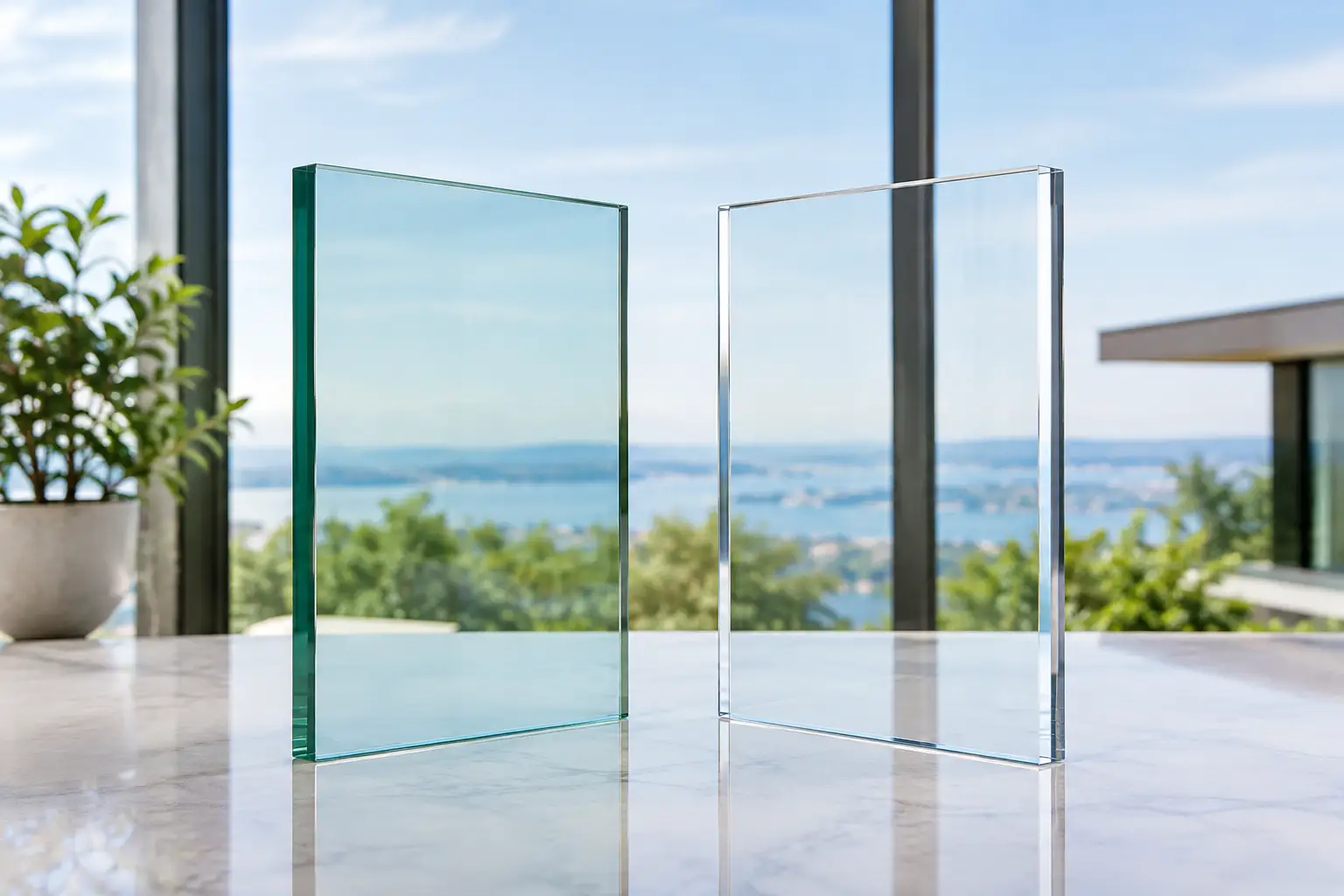
A low-E coating may have a slight reflectivity or color cast. On a carefully detailed residence, that visual effect should be reviewed in person whenever possible. A neutral coating typically suits contemporary homes where the intent is to make the glass visually recessive. A subtle gray or bronze tint can be appropriate when it reinforces a darker metal finish, provides additional glare control, or suits the palette of the exterior.
Be cautious with heavily tinted glass simply because it seems like a shortcut to solar control. It can alter the color of ocean views, reduce daylight, and make an interior feel closed in on overcast days. A refined low-E package often provides a better result than a dark tint alone.
Tempered and Laminated Glass Serve Different Purposes
Safety glazing is essential for patio doors. Tempered glass is heat-treated to be considerably stronger than standard annealed glass and, when broken, is designed to fragment into small pieces rather than dangerous shards. It is the familiar choice for many sliding and swinging glass doors.
Laminated glass consists of two panes bonded with an interlayer. If the glass breaks, the interlayer helps hold fragments in place. This makes laminated glass particularly valuable where impact resistance, security, fall protection, or enhanced acoustical performance is required. It can also help reduce ultraviolet transmission, protecting interior finishes that receive direct sun.
The right choice depends on the opening and applicable code. In certain coastal or high-wind conditions, the door may need to meet specific structural and impact-performance requirements. Large panels, elevated installations, glass near a pool environment, and doors with unusual configurations can introduce additional engineering considerations.
Do not assume every safety-rated pane performs the same way. Thickness, interlayer type, insulated-glass construction, panel size, hardware, and framing system all affect the final assembly. Architectural glazing should be specified as a system, not as a piece of glass selected independently from its frame.
The Best Patio Door Glass for Noise Control
A beautiful view loses some of its value if traffic, aircraft, neighborhood activity, or surf-zone wind constantly enters the room. For homes near PCH, active resort areas, or dense coastal neighborhoods, acoustic performance can be a meaningful part of the specification.
Laminated glass is often the most effective starting point for reducing sound transmission because its interlayer dampens certain sound frequencies. An insulated unit that uses differing glass thicknesses can improve performance further by disrupting sound waves that pass readily through matching panes. This is known as an asymmetrical glass construction.
However, glass alone will not solve a noise issue. Large door panels must close precisely, weatherstripping must be continuous, and the frame must be installed to maintain its intended seals. A high-performing glass package in a poorly fitted door will not deliver the quiet expected of a luxury residence.
Large Openings Require More Than Better Glass
Contemporary architecture frequently calls for oversized sliding doors, pocketing systems, lift-and-slide panels, and expansive folding walls. These openings create exceptional indoor-outdoor connections, but their scale changes the technical conversation.
As panel dimensions increase, glass weight rises quickly. A thicker pane or laminated configuration may be necessary for structural performance, while the hardware must be capable of carrying that load over years of daily operation. Deflection under wind pressure, water management at the sill, threshold transitions, and integration with waterproofing are equally important.
For ocean-view terraces and elevated balconies, glass selection may also be tied to railing, guard, or wind-load requirements. The most elegant result often comes from coordination early in design, before framing dimensions, floor elevations, and drainage details have been finalized.
This is where showroom review can be especially useful. Full-scale door and glass displays reveal details that samples cannot: reflected color at a distance, handle proportions, panel movement, threshold depth, and the relationship between the glass edge and surrounding architecture.
Do Not Overlook Surface Protection and Maintenance
Coastal air, irrigation overspray, pool water, and hard-water minerals can permanently mark unprotected glass. Patio doors near a pool or exposed terrace are especially vulnerable because mineral deposits repeatedly dry on the surface. Over time, this can create haze, spotting, and corrosion that ordinary cleaning will not remove.
A professional protective treatment can make exterior glass easier to maintain by helping water and contaminants release from the surface. It is most effective when applied to clean, new glass or after proper restoration of existing affected panels. The treatment does not eliminate maintenance, but it can reduce the effort required to keep a large door wall clear and presentable.
Avoid abrasive pads, harsh powders, and unverified chemicals. They can damage coatings, scratch glass, or degrade surrounding finishes. For a substantial architectural door system, maintenance guidance should account for the glass, metal cladding, tracks, rollers, seals, and drainage paths.
A Better Way to Specify Patio Door Glass
The most dependable process begins with the architectural intent: what should the opening feel like from inside and outside? Then evaluate sun exposure, desired daylight, view quality, privacy, sound, safety, structural loads, energy targets, and maintenance conditions. Material samples and manufacturer performance data should support that decision, not replace it.
For demanding residential and hospitality projects, Capistrano Valley Glass & Mirror approaches patio door glass as architectural glazing rather than a commodity component. The distinction matters when a door system must perform beautifully across a wide opening, withstand coastal conditions, and remain visually precise beside stone, wood, metal, and custom finishes.
A well-specified patio door should disappear when you are looking through it and inspire confidence when weather, use, and time test it. Choose the glass package that protects the comfort of the room without compromising the reason the opening was created in the first place: the view.