A glass pool barrier can preserve a view from the terrace, frame a resort-style water feature, and keep sightlines open from the house. But the best pool fence hardware is rarely the most decorative piece in a showroom. It is the hardware that carries the glass safely, operates predictably for years, resists its environment, and supports a barrier design that can satisfy the applicable code.
For coastal Southern California properties, that standard matters. Salt air, irrigation overspray, hard water, intense sun, and daily use can expose weaknesses that are not apparent on installation day. A refined result depends on treating hinges, latches, spigots, channels, anchors, and fasteners as a coordinated architectural glazing system.
Pool Fence Hardware Is a Structural Decision
Frameless glass pool fencing has a visual lightness that can be misleading. Each panel is heavy safety glass, and the hardware transfers its load into concrete, decking, steel, or a supporting structure. The glass, hardware, substrate, and attachment method must be considered together.
A low-profile clamp may suit a short, protected run on a properly engineered curb. The same clamp may be the wrong choice for a tall panel exposed to canyon winds, an elevated deck, or a frequently used gate opening. Similarly, a recessed base channel can create an exceptionally clean appearance, but it requires early coordination with the waterproofing, drainage, finish materials, and structural support below.
This is why premium pool fencing should not be selected from a hardware finish alone. The right specification begins with the barrier layout, glass dimensions, panel spacing, gate location, site exposure, and the condition of the supporting surface. Hardware is the visible expression of those decisions, not a substitute for them.
Choosing the Best Pool Fence Hardware
The best pool fence hardware depends on the role each component performs. Fixed panels, corner conditions, gate panels, and transitions to walls or railings have different loading and operational requirements.
Hinges and latches deserve the closest scrutiny
The gate is the moving, code-sensitive element of the barrier. Its hinges must support the weight of the glass without sagging, binding, or losing closing force over time. Quality glass-to-glass and glass-to-wall hinges are engineered for a defined glass thickness and maximum panel size. Exceeding those limits to achieve a wider, more dramatic gate is not a design upgrade. It is a risk that should be resolved through a different layout or a properly engineered system.
For most pool applications, self-closing hinges and a self-latching mechanism are essential. The gate must close reliably from normal opening positions, not only when tested carefully by hand. Hydraulic or spring-assisted hinge systems can both be appropriate, depending on gate size, wind exposure, desired movement, and maintenance expectations.
The latch should be easy for authorized adults to operate while satisfying applicable pool-barrier requirements. Its position, release mechanism, gate swing, and relationship to nearby climbable elements should be reviewed during design, before glass is ordered. A handsome latch that conflicts with the approved barrier configuration is simply the wrong latch.
Spigots, clamps, and channels create different visual results
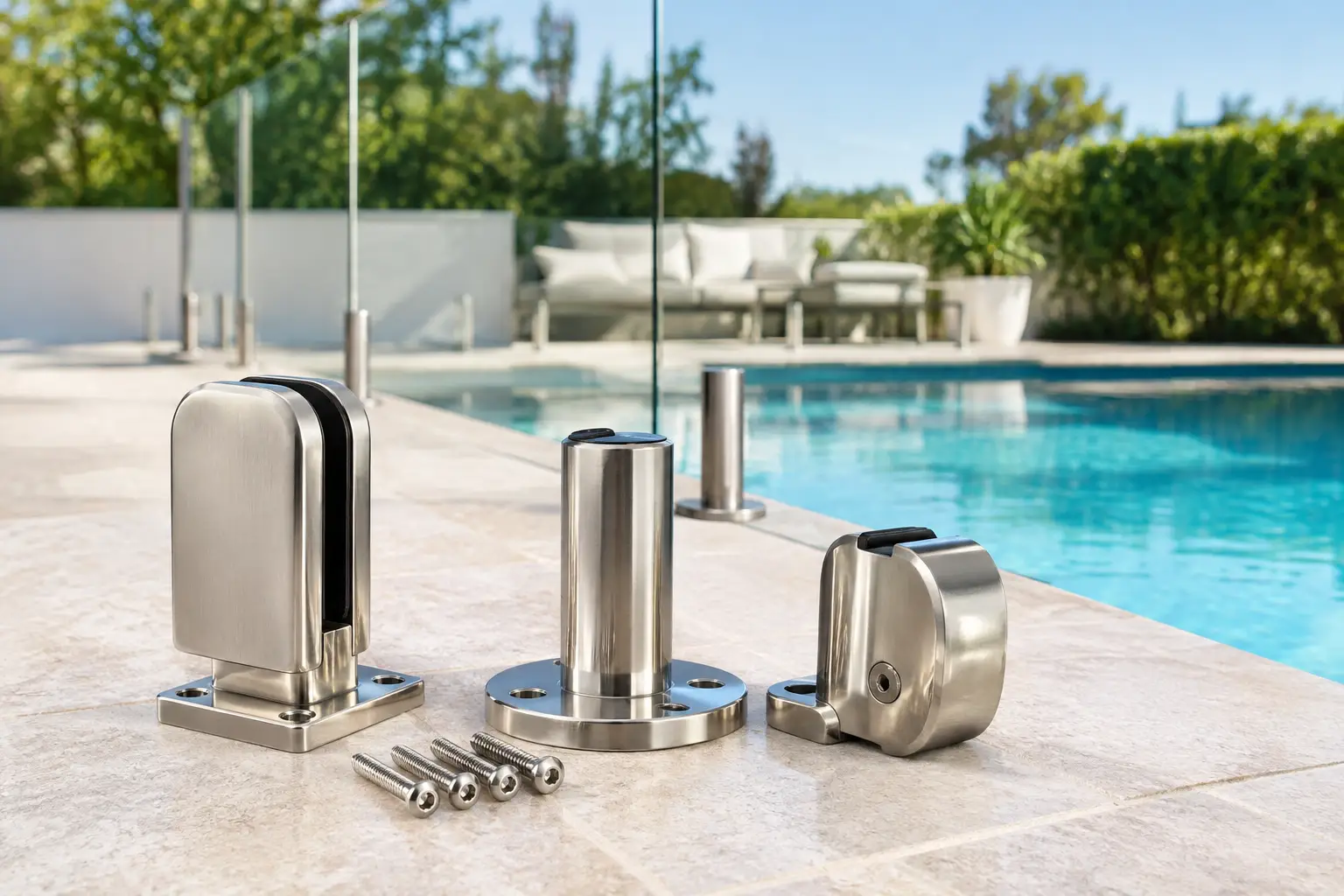
Surface-mounted spigots are a popular choice for contemporary pool decks because they keep the glass elevated above the finish surface and allow water to drain beneath it. They also create a clean, repeatable rhythm along a straight run. Their suitability depends on the concrete thickness, reinforcing, edge distances, and the engineered anchoring method.
Glass clamps can be effective where the design calls for a lighter hardware expression or where panels meet posts, walls, or a supporting rail. Their compact scale does not eliminate structural demands. Clamp spacing, glass edge clearances, gasket selection, and mounting substrate are all part of the system.
A shoe or base channel offers the most minimal frameless appearance, with the glass appearing to rise directly from the deck. It is often selected for view-facing terraces and higher-design pool environments. It can also be the most coordination-intensive option. The channel requires sound attachment, accurate setting, compatible drainage details, and careful waterproofing where it penetrates or sits adjacent to finished surfaces.
No one mounting style is universally superior. Spigots may be the practical choice for a completed stone deck. A recessed channel may be worth planning into a new-build terrace. The appropriate answer follows the architecture and construction conditions.
Anchors and fasteners are not minor components
Stainless steel hardware is only as dependable as the fasteners and anchors concealed within the installation. Hardware packages should be specified as complete assemblies, with compatible bolts, sleeves, gaskets, setting blocks, and isolation materials where required.
Improvised substitutions can introduce corrosion, inadequate embedment, or inconsistent loading behavior. On a luxury project, this is not merely a technical concern. Staining around a base plate, loose movement at a spigot, or a misaligned gate immediately undermines the precision of the entire outdoor space.
Material Selection for Coastal California
For many pool environments in Orange County and other coastal areas, 316 stainless steel is the prudent starting point for exposed hardware. It offers improved corrosion resistance compared with lower-grade stainless, particularly where salt-laden air, pool chemicals, and moisture are present. It is not maintenance-free, however. Chlorides can still affect stainless steel if deposits are allowed to remain on the surface.
Finish selection should support both the architecture and the exposure conditions. Brushed stainless can be forgiving with fingerprints and everyday use. Polished stainless delivers a more formal reflective quality but shows water spotting more readily. Matte black and custom powder-coated hardware can create a strong architectural contrast, though finish quality and manufacturer suitability for exterior pool conditions should be confirmed.
Avoid mixing metals casually. Contact between dissimilar metals, especially in wet conditions, can accelerate galvanic corrosion. The same caution applies where hardware meets aluminum elements, steel framing, or certain stone and masonry details. Proper isolation and compatible materials protect the work that remains unseen.
Code-Conscious Design Starts Before Fabrication
Pool-barrier codes are not an afterthought to a glass fence. They influence gate configuration, latch placement, clearances, barrier height, openings, adjacent landscaping, and access routes. Requirements can vary by jurisdiction and project type, while California and local authorities may impose specific provisions for residential pools, remodels, and multifamily or hospitality properties.
A glass panel may look continuous while leaving a gap that does not meet the required limitation. A planter, bench, equipment enclosure, or decorative ledge near the barrier may create a climbable condition. A gate may be perfectly aligned but swing in the wrong direction for the approved layout. These issues are far less expensive to solve on drawings than after stone, concrete, and glass are in place.
The proper process is to verify the governing requirements with the authority having jurisdiction and coordinate the glass barrier with the architect, builder, landscape designer, and pool contractor. For complex homes and hospitality settings, the assembly may also require engineering based on glass dimensions, wind exposure, and supporting conditions.
Protecting the Hardware and Glass After Installation
Pool fencing needs routine attention, especially near the coast. Rinse exposed stainless hardware periodically with fresh water, then dry it with a clean soft cloth. Avoid abrasive pads, chloride-containing cleaners, and harsh acid products that can damage finishes or leave contaminants behind. Gate operation should be checked regularly so closing speed, latch engagement, and alignment can be corrected before they become a larger issue.
Glass deserves the same care. Mineral deposits from sprinklers and hard water can etch a panel over time, turning a clear barrier cloudy and difficult to clean. Protective glass treatments can reduce the adhesion of water spots and contaminants when applied to clean, properly prepared glass. For existing enclosures with staining, corrosion, or surface damage, restoration may be a viable alternative to replacement when the glass itself remains structurally suitable.
At Capistrano Valley Glass & Mirror, pool fencing is approached as architectural glazing: a system where material quality, fabrication accuracy, site conditions, and installation discipline all affect the finished result.
Specify the Barrier Before the Deck Is Finished
The most successful glass pool barriers feel inevitable, as though the architecture was designed around them from the beginning. That outcome usually comes from early decisions: establish the required barrier path, select the mounting strategy, confirm structural support, coordinate drainage and waterproofing, and choose hardware built for the site rather than merely styled for it.
When the details are resolved early, the hardware can do what exceptional hardware should do: hold the line quietly, operate with confidence, and leave the water, landscape, and view in clear sight.